

- Home
- Products
- HOT
- Technology
- Service
- Resources
- About
- Contact
- All
- Product Name
- Product Keyword
- Product Model
- Product Summary
- Product Description
- Multi Field Search

Views: 0 Author: Site Editor Publish Time: 2026-07-16 Origin: Site


Ice hockey is a game of incredible speed and undeniable physical reality. Players face high-speed collisions, unyielding boards, and rock-hard ice every time they step onto the rink. These extreme conditions require equipment evaluated on objective safety metrics rather than just visual aesthetics. The hard plastic outer shell of a helmet deflects initial contact to prevent skull fractures. However, the internal liner acts as the critical mechanism for energy dispersion and rapid deceleration.
Many players mistakenly focus entirely on the exterior shell, ignoring the foam or lattice structure inside. Upgrading your gear requires looking past flashy brand marketing campaigns. We must understand how liner density, material composition, and precise fit dictate actual head protection. You will learn to evaluate safety standards and choose the right internal technologies to maximize your safety on the ice.
Deconstructing the helmet system reveals a dual-purpose design. The outer polycarbonate shell provides crucial puncture resistance. It handles the initial deflection when a stray puck or stick strikes the head. The shell acts as the first line of defense against localized fractures. Beneath this rigid barrier sits the inner liner. The liner takes on the heavier burden of energy absorption and skull deceleration. If the shell is the armor, the liner is the shock absorber.
Players face two primary types of forces during a game. Linear impacts occur during direct hits to the boards or the ice. Imagine catching an edge and falling straight backward. The back of the head strikes the ice in a straight line. Rotational or angular forces present a more complex challenge. These occur from glancing blows, such as taking a shoulder check to the side of the jaw. The impact causes rapid head rotation. Medical professionals identify these rotational forces as a primary factor in concussive events. The brain twists inside the skull, leading to severe neurological trauma.
We must explicitly state a crucial reality regarding head protection. No helmet can completely prevent concussions. Concussions happen internally when the brain collides with the inner skull walls. The ultimate goal of a reliable head protective ice hockey helmet is impact mitigation. It reduces the physical force threshold reaching the brain. A high-quality liner slows the head down over a few extra milliseconds. Those fractions of a second matter immensely in reducing trauma severity, but they do not grant the wearer invincibility.
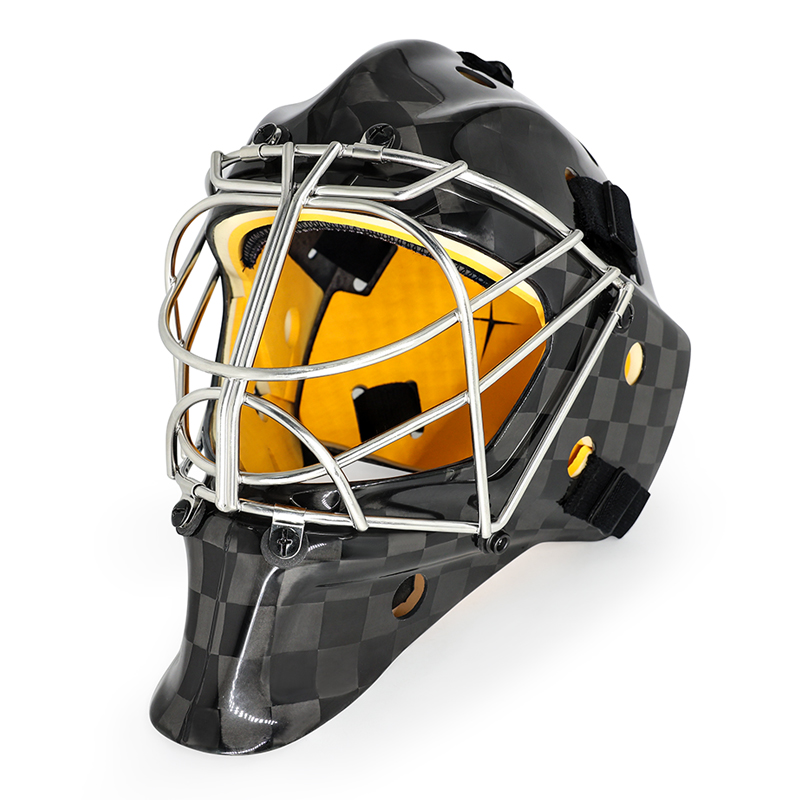
Legacy materials dominate older models and entry-level gear. For decades, Vinyl Nitrile (VN) foam was the industry standard. VN feels softer against the head and compresses easily. It provides excellent comfort and boasts multi-impact memory. This means it returns to its original shape quickly after a hit. However, VN has a major limitation. It can bottom out under severe, high-velocity impacts. When the foam compresses fully, residual energy transfers directly to the skull.
Manufacturers later introduced Expanded Polypropylene (EPP) to solve this issue. EPP behaves much like the foam found in bicycle helmets. It feels significantly stiffer. EPP handles catastrophic, single-impact energy dispersion highly effectively. It excels at managing massive linear forces. Because of its rigidity, EPP usually requires secondary layers of soft comfort foam to make the helmet wearable.
Next-generation technologies merge these concepts to handle varying impact velocities efficiently. Multi-density layering combines EPP bases with VN comfort layers. This dual-density approach manages both minor bumps and major collisions.
The modern 3D printed helmet liner represents a structural leap forward. Rather than using solid blocks of foam, engineers design intricate lattice geometries. They use specialized elastomeric resins. Upon impact, these lattice struts buckle and shear strategically. This distinct buckling action disperses both linear and rotational forces simultaneously. The open structure also inherently solves the breathability issue. Foam blocks trap body heat. Porous 3D printed structures allow air to flow freely, offering superior sweat management.
| Material Type | Impact Management | Comfort & Fit | Heat/Sweat Management |
|---|---|---|---|
| Vinyl Nitrile (VN) | Good for low/medium velocity; multi-impact memory. | Very soft, molds well to different head shapes. | Poor. Dense foam traps heat. |
| Expanded Polypropylene (EPP) | Excellent for high-velocity linear impacts. | Very stiff; requires additional soft padding layers. | Moderate. Often features molded air channels. |
| 3D Printed Lattice | Superior linear and rotational force dispersion. | Highly customizable, responsive to pressure points. | Excellent. Open porous structure maximizes airflow. |
Baseline certifications define the minimum safety thresholds required for organized play. The Hockey Equipment Certification Council (HECC) in the US, the Canadian Standards Association (CSA), and European Conformity (CE) run rigorous evaluations. These organizations ensure every helmet meets standardized criteria before hitting retail shelves.
What do these agencies actually test? Standard laboratory drop-tests measure peak gravitational force reduction. Technicians strap the helmet to a magnesium headform. They drop it onto an anvil from specific heights. Sensors inside the headform record the g-force. Most standards require the helmet to keep the impact below a 275g or 300g threshold. Lab testing differs slightly from unpredictable ice reality, but it provides a reliable, repeatable safety baseline.
Buyers must understand the strict expiration rule associated with these certifications. Helmet certifications expire. HECC stickers usually lose validity after 6.5 years from the manufacturing date. Referees check these stickers before competitive games.
Furthermore, internal liners degrade over time due to environmental factors. You must replace the unit eventually, regardless of how pristine the outer shell looks.
A common trap ensnares many equipment buyers today. We call it the "premium misconception." Players assume buying a $400 helmet guarantees maximum safety. However, an advanced liner becomes an active safety risk if fitted poorly. A high-end shell leaving gaps around the temples or occipital bone compromises protection entirely. During an impact, a loose helmet shifts. The energy bypasses the liner and transfers directly to the skull. A basic, properly fitted ice hockey player helmet outperforms an ill-fitting premium model every time.
Objective criteria help you evaluate fit during the buying process. Never guess your size. Use these testing methods to verify the lock on your head:
Acknowledge cranial diversity. Human head shapes differ wildly. Different brands use proprietary head forms for their molds. Some lines cater exclusively to oval heads. Others build wider shells for round heads. You might measure as a medium, but a medium oval helmet will aggressively pinch a round head. Buyers must evaluate helmets based on specific cranial shape. Blind brand loyalty often leads to painful pressure points and compromised safety.
Start your buying journey by auditing your existing gear. Squeeze the foam inside your current helmet. If it feels rock hard or crumbles, the material has failed. Check the mechanical components. Look for rusted screws, cracked plastic J-clips, or warped ear guards. Finally, verify the date on your HECC or CSA sticker. If the sticker has expired, replacement is mandatory for league play. These simple criteria determine if you need an upgrade immediately.
Budgeting for protection depends largely on your play level and exposure to risk. Entry-level and recreational players usually participate in non-checking leagues. Their primary risks involve accidental falls or stray sticks. At this level, focusing on dual-density foams offers excellent protection. Perfect fit remains your absolute highest priority.
Elite and competitive players face much higher impact velocities. Body checking, heavy slap shots, and intense board battles are guaranteed. Justifying the return on investment for a modern lattice structure or rotational management system makes sense here. Faster game speeds require faster, more sophisticated energy dispersion materials to keep players safe.
Take clear, action-oriented next steps. Visit a dedicated hockey pro shop for professional sizing. Use a soft tape measure to find your exact head circumference. Ask the staff to bring you multiple models blindly. Do not look at the price tags or brand logos first. Put them on and let the fit dictate your choice. Bring your current mouthguard and shoulder pads to the fitting session. Bulky shoulder pads can push up on the back of a helmet if the profile sits too low. Testing everything together ensures proper neck clearance and jaw alignment.
The true value of head protection always lies beneath the outer polycarbonate shell. Advancements in liner materials offer measurable, scientifically proven improvements in energy dispersion. Transitioning from basic EPP foams to complex 3D printed lattices pushes player safety boundaries forward. They manage both linear and rotational forces with incredible efficiency.
However, these advanced materials only deliver on their safety promises under strict conditions. They demand rigorous lab certification and a flawless, gap-free fit. Without proper sizing, even the best technology fails upon impact.
Take action today. Urge your teammates and equipment managers to audit their current gear. Check thoroughly for foam degradation, rusted hardware, and expired certification stickers. Do this before your next scheduled ice time. Protect your brain by ensuring your liner remains fully capable of absorbing the game's hardest hits.
A: Most certification bodies mandate replacement every 5 to 6.5 years. HECC stickers explicitly list an expiration date. Beyond regulatory rules, foam degradation dictates replacement. Sweat acidity, UV exposure, and routine impacts harden the internal foam over time. Replace it sooner if you notice brittle liners or severe shell impacts.
A: They offer superior multi-directional impact dispersion. Lattice structures buckle strategically to manage both linear and rotational forces simultaneously while providing better heat management. However, standard dual-density foam still passes all required safety thresholds. A perfectly fitted traditional foam model always protects better than an ill-fitting 3D printed version.
A: No. Manufacturers structurally integrate liners into the shell to meet strict HECC and CSA testing standards. Removing old foam and installing aftermarket parts voids all safety certifications. This modification alters the energy dispersion mechanics and puts you at significant risk. Always replace the entire helmet unit.
A: Human heads generally fall into oval or round shapes. If a helmet squeezes your temples but fits front-to-back, you likely have a round head in an oval-shaped shell. Sizing up reduces safety by creating front-to-back gaps. Instead, switch to a different brand's shell profile designed for wider heads.

