

- Home
- Products
- HOT
- Technology
- Service
- Resources
- About
- Contact
- All
- Product Name
- Product Keyword
- Product Model
- Product Summary
- Product Description
- Multi Field Search

Views: 0 Author: Site Editor Publish Time: 2026-07-12 Origin: Site


Many adult and transitioning players face a difficult equipment dilemma when stepping onto the ice. They must constantly balance maximum facial protection against perceived visibility and breathability constraints. Choosing the right facial protection requires weighing significant personal stakes. Dental reconstructions and severe facial lacerations carry heavy physical and financial costs. Conversely, adapting to full-face protection only requires a brief initial adjustment period. This guide provides an objective framework for your equipment decision. We will help you determine if an ice hockey helmet with cage or a full clear shield makes the right investment. You will learn how to navigate league rules, assess performance needs, and evaluate your personal risk tolerance. By understanding these core elements, you can select a setup ensuring both safety and peak performance.
Sometimes, the choice of equipment is completely out of your hands. Governing bodies dictate strict equipment standards to minimize severe injuries on the ice. Before shopping for new gear, you must check local rulebooks. Many leagues enforce non-negotiable rules regarding facial protection. Understanding these baseline rules prevents you from buying incompatible equipment. It also ensures you remain eligible for official gameplay.
USA Hockey and Hockey Canada enforce stringent rules for younger athletes. High school and collegiate players must wear HECC (USA) or CSA (Canada) certified full facial coverage. These strict mandates leave no room for half-shields or visor-only setups. Governing bodies rely on extensive injury data to support these rules. Statistics show a massive reduction in orbital fractures and dental trauma when players use full protection. Therefore, transitioning youth players have no choice but to adapt to full facial coverage early in their careers.
Adult recreational leagues typically allow players to choose their protection level. However, these "beer leagues" present a highly unique risk profile. You face wildly varying skill levels every single game. Accidental high sticks and unpredictably deflected pucks happen frequently. Many recreational players simply lack elite stick control. Furthermore, fatigue late in shifts often leads to careless stick positioning. Consequently, opting out of full-face protection dramatically increases your injury risk. You must objectively evaluate the environment before dropping your cage. Protecting your teeth and eyes should outweigh the desire to emulate professional players.
Every ice hockey helmet and its attached cage carries an official expiration date. Manufacturers rigorously test these components to withstand impacts for a specific duration. Materials degrade over time due to sweat, UV exposure, and repeated minor impacts. An expired helmet instantly voids league compliance. Furthermore, an expired setup might jeopardize your insurance coverage if a serious injury occurs on the ice. Always check the HECC or CSA sticker located on the back of the helmet. If the date has passed, you must replace the unit immediately, regardless of its visual condition.
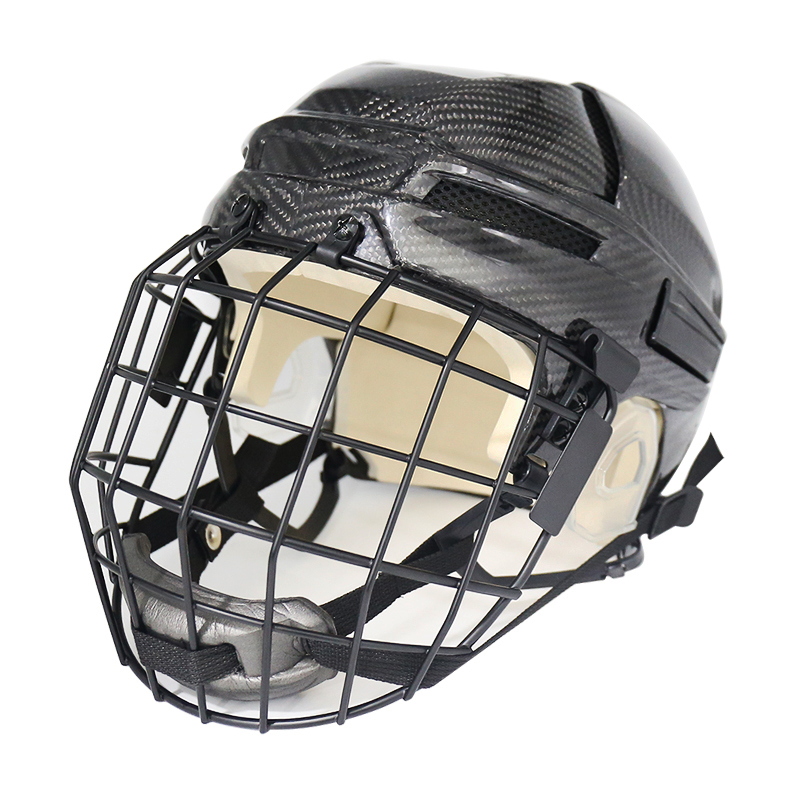
You essentially have two primary categories for achieving total facial coverage. You can choose a traditional wire grid or a transparent polycarbonate shield. Both options provide excellent impact protection. However, they manage airflow and visibility in fundamentally different ways. Let us break down these two approaches to help you decide.
A full face helmet cage uses interconnected metal bars to form a rigid protective barrier.
These high-impact polycarbonate masks wrap around the entire face, mimicking the look of a motorcycle visor.
You might also consider the half-shield/half-wire combination. This hybrid setup offers clear vision up top and a breathable wire grid below. It remains a niche market adoption but serves as a solid middle-ground solution. It attempts to combine the best visual elements of a shield and the breathing elements of a cage.
| Feature | Traditional Wire Cage | Full Clear Shield | Hybrid Combination |
|---|---|---|---|
| Airflow | Excellent ventilation | Highly restricted | Moderate lower ventilation |
| Visibility | Grid line interference | Panoramic, unobstructed | Clear upper, grid lower |
| Maintenance | Zero maintenance required | Constant anti-fog application | Moderate anti-fog required |
| Durability | Extreme impact resistance | Prone to surface scratches | Visor prone to scratches |
How does a facial protection setup impact your on-ice mechanics? We evaluate this through three critical dimensions. We must look at visual tracking, physical balance, and thermal regulation. Each factor plays a massive role in your overall comfort and game performance.
Many players deeply fear the visual grid of a wire cage. However, you will quickly experience a biological "brain filter" effect. The human eye naturally looks past wire cages after a brief transition period. Because the bars sit so close to your eyes, your binocular vision blurs them out. Your brain learns to stitch the background image together seamlessly. Soon, you rarely notice the bars at all. You can speed up this adaptation by wearing the helmet around your house before hitting the ice.
A traditional steel cage shifts your center of gravity slightly forward. You might feel a slight pull on your neck during sudden stops or aggressive turns. We must evaluate if titanium upgrades make sense for your situation. Titanium costs significantly more but reduces mask weight by up to fifty percent. For frequent players, this drastic reduction improves long-term comfort. It also noticeably reduces neck fatigue during tournaments or back-to-back games.
Hockey generates massive amounts of body heat. A standard cage provides open, superior ventilation. Sweat evaporates quickly, and cool arena air flows freely across your face. Contrast this open design against a full clear visor. The solid plastic visor inevitably retains heat around your face. You will sweat more, which often leads to moisture pooling near the chin cup. If you run hot naturally, a full clear shield might feel overwhelmingly stifling during high-exertion shifts.
Many players casually buy the same size cage as their helmet. This represents a very common and potentially dangerous mistake. A medium helmet does not automatically require a medium cage. Sizing depends entirely on your facial length, not your skull circumference. Wearing an improperly sized mask compromises its structural integrity. It can also cause severe discomfort or jaw injuries upon impact.
We must follow a strict fit framework to guarantee safety. The chin cup dictates the effectiveness of the entire mask. It must sit completely flush against the bottom of your chin. It should never float above the chin. It must not press uncomfortably into your throat. When you open your mouth, the cup should remain securely cupped around your jawline. If it slips upward, you need a longer cage. If it hangs loosely, you require a shorter model.
You need specific hardware to mount a cage safely. This includes J-clips, top mounting screws, and side strap buckles. Cross-brand compatibility exists, but it varies wildly. Fitting a CCM mask onto a Bauer shell often works. However, you must verify the alignment physically. The J-clips must catch the mask sides perfectly. These clips stop downward impacts from driving the metal into your jaw. Never play if the mask misses the J-clips entirely.
Follow this sequential checklist for mounting and adjusting a cage safely. You want to avoid stripping the receiving threads inside the plastic shell.
You must logically match the solution to your specific reality. Different skill levels require totally different equipment priorities. Assessing your current stage in the game helps narrow down the perfect choice.
We strongly recommend a standard wire cage for all beginners. Beginners need maximum physical protection and absolutely zero maintenance. When learning spatial awareness and edge control, you fall frequently. You avoid worrying about fogging issues or scratching an expensive plastic shield. A standard cage lets you focus entirely on developing fundamental skills safely.
We recommend titanium cages for ultimate weight savings. Alternatively, select a full clear shield if you prioritize unobstructed vision over heat management. High-level recreational players often prefer the panoramic view to track fast passes through heavy traffic. Just be prepared to manage the anti-fog routine diligently in the locker room before puck drop.
Aging out of youth hockey presents a major mental shift. Many players consider dropping their full protection for a half-visor. Peer pressure often drives this dangerous transition. We strongly advise against this move. We advocate for retaining full-face protection based on objective injury data. Massive dental bills far outweigh the perceived cool factor of a half-visor. Keep your full setup and protect your face for the rest of your playing career.
Choosing your facial protection involves a fundamental trade-off. You might experience a minor adjustment in peripheral tracking or breathing. However, eliminating massive dental and facial injury risks easily outweighs this small inconvenience. Safety should always remain your primary focus when navigating the ice.
The best setup is always the one fitting securely. It must match your specific physiological needs, carefully balancing cooling demands against visual clarity. A poorly fitted mask offers a false sense of security.
Take proactive action before your next skate. Verify your current helmet’s certification sticker immediately. Measure your facial length accurately from the brow line to the chin. Always test the physical fit before purchasing a new mask to ensure maximum safety and peak performance on the ice.
A: Generally, yes. Most major brands design their cages to universally align with standard mounting points. Brands like Bauer, CCM, and Warrior usually intermix well. However, fitment and J-clip alignment should always be physically tested before playing to ensure maximum impact resistance.
A: NHL rules mandate visors for players entering the league. They strictly prohibit full cages unless a player is actively recovering from a specific facial or dental injury. The professional league prioritizes maximum visibility, player identification, and fan marketability over absolute facial protection.
A: Use designated hockey anti-fog sprays meticulously before every single skate. Avoid touching the inside plastic with bare hands, as skin oils degrade the protective coating. Ensure your helmet sits correctly on your head to allow whatever minimal venting exists to function properly.
A: For players sensitive to the front-heavy feel of a standard steel mask, yes. Titanium offers a massive 30-50% weight reduction. It is also highly resistant to rusting, making it a highly viable long-term investment for frequent, competitive players.

