

- Home
- Products
- HOT
- Technology
- Service
- Resources
- About
- Contact
- All
- Product Name
- Product Keyword
- Product Model
- Product Summary
- Product Description
- Multi Field Search

Views: 0 Author: Site Editor Publish Time: 2026-07-08 Origin: Site


Step onto any rink, and you will quickly notice a stark divide. Hockey purists often cling to a visor-only culture. They wear half-shields proudly as a badge of honor. Yet, the practical reality of stray sticks and deflected pucks paints a much different picture. Players moving from minor hockey mandates into adult leagues face a crucial decision. They must choose between the minimal coverage of a half-shield and the maximum safety of full-face protection. This particular choice shapes their future on the ice. We must frame the full-face ice hockey cage not as a beginner's compromise, but as a calculated investment. It ensures career longevity and prevents massive medical costs. It also builds undeniable on-ice confidence. When you eliminate the fear of catching a stick to the teeth, you battle harder in the corners. Your overall performance naturally improves. Understanding this shift helps you prioritize safety without sacrificing your competitive edge. You gain peace of mind during every single shift.
Clinical sports medicine data reveals startling statistics. Studies published in reputable medical journals consistently track facial trauma in contact sports. Players wearing half-visors face drastically higher risks of orbital bone fractures and complex dental avulsions. The lower face remains entirely exposed to rising slap shots and errant stick blades. We see these severe injuries disrupt adult leagues constantly. High-speed pucks do not discriminate based on your skill level.
Let us look at the stark financial reality. Purchasing a premium, high-end cage requires a one-time investment. You will spend roughly $60 to $100. Conversely, emergency dental implants often exceed $3,000 per tooth. Facial laceration repairs add massive emergency room fees. You cannot ignore this basic math. A single deflected shot pays for the equipment fifty times over. You protect your wallet as much as your face.
Professional players wear visors for specific, negotiated reasons. NHLPA union agreements dictate equipment standards. Television broadcasts demand clear player visibility for marketing and fan engagement. This dynamic creates an unwritten locker room culture. Replicating this professional standard in recreational or collegiate environments introduces immense, unnecessary risk. You do not have access to an NHL team's private medical staff.
High-traffic drills cause frequent, unpredictable friendly fire. Deflections happen constantly during chaotic warm-ups. Utilizing a practice ice hockey cage heavily minimizes these acute risks. It protects you during aggressive corner battles. Furthermore, maintaining visual consistency between practice and games improves your hand-eye coordination. Changing your visual field between Tuesday practice and Thursday games harms your puck tracking.
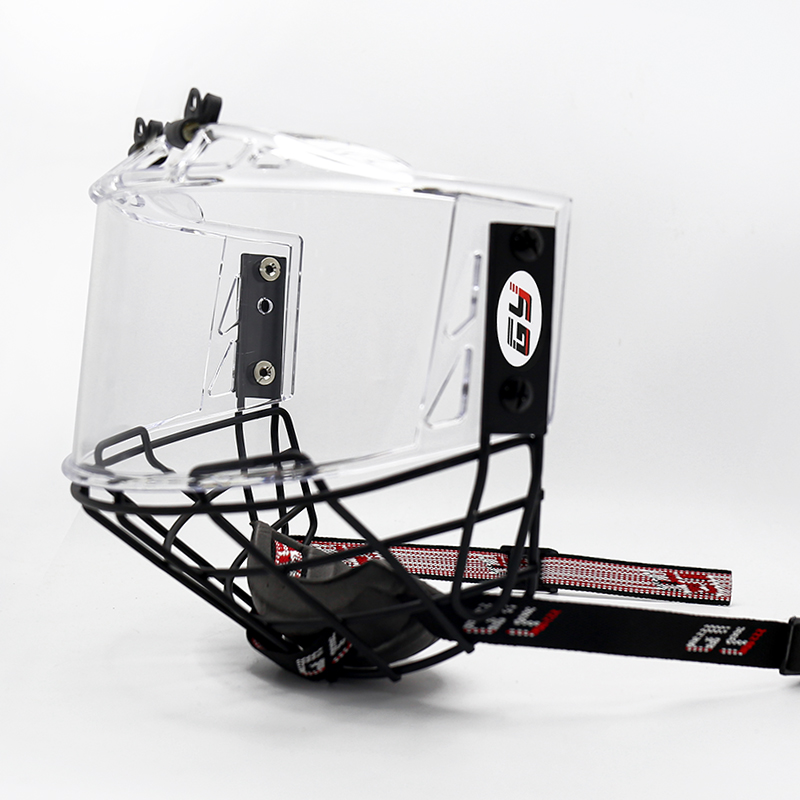
Governing bodies across North America prioritize amateur player safety above all else. The NCAA strictly enforces full-face mask requirements for all collegiate athletes. USA Hockey and Hockey Canada maintain similar mandates for youth hockey and specific amateur tiers. You must understand these rules thoroughly before stepping onto the ice. Officials will penalize or immediately eject players wearing illegal or modified equipment.
Adult recreational leagues operate under rigid liability insurance policies. They require everyone to sign liability waivers. Wearing a fully certified ice hockey player cage actively maintains your waiver coverage. If you suffer a severe facial injury while wearing a non-compliant or altered visor, league insurance providers might deny your medical claims. They view the missing lower facial protection as personal negligence.
You must physically verify equipment safety ratings. Always look for valid HECC certification stickers in the United States. Canadian players must check for CSA approval stickers. These organizations rigorously test equipment against severe, high-velocity impact forces. Expired stickers indicate metal fatigue might compromise safety. Referees actively check these expiration dates during major tournaments. A missing sticker disqualifies the helmet instantly.
Players must choose the exact style for their specific biological needs and rink conditions. Three primary categories currently dominate the hockey equipment market.
These unique units combine clear upper vision with critical lower-face breathability. You must honestly assess if this combination justifies the premium price point. They demand mixed, careful maintenance requirements. You must gently clean the polycarbonate visor while simultaneously keeping the lower cage wires completely rust-free.
Face Protection Category Comparison Matrix
| Protection Type | Visibility Quality | Airflow / Breathability | Required Maintenance | Fog Risk Level |
|---|---|---|---|---|
| Wire Cage | Good (Bars visible initially) | Excellent | Low | None |
| Polycarbonate Bubble | Excellent (Completely Clear) | Moderate | High | High |
| Hybrid Shield | Excellent (Clear Top Half) | Good | Moderate | Moderate |
Many veteran players resist full facial coverage due to perceived historical drawbacks. Practical experience proves these concerns largely stem from outdated equipment myths.
Beginners often complain intensely about seeing the metal bars. Optical science explains a very different functional reality. The human brain utilizes binocular vision to naturally look past the thin bars. This neural adaptation typically takes only two to three ice sessions. Your focal point shifts dynamically to objects at a distance. The so-called "blind spot" myth simply vanishes once your brain adapts to the new framing.
Older equipment felt incredibly heavy and severely unbalanced. Modern engineering decisively solves this historical problem. Traditional carbon steel remains highly budget-friendly but carries extra physical weight. Modern titanium alloys offer an ultra-light, premium alternative. They belong to the highest equipment tier. Titanium significantly reduces chronic neck fatigue during grueling overtime games.
Fit determines both your comfort and your physical safety. A poorly fitted chin cup causes severe skin chafing. It harshly restricts your natural jaw movement when calling out plays. More importantly, it fatally compromises kinetic impact dispersion. When a heavy slap shot strikes the mask, the chin cup must absorb and distribute the massive shock. If it hangs too loosely, the metal framework impacts your jaw directly.
Purchasing protective equipment requires careful, methodical evaluation. Do not simply grab the first shiny option off the retail shelf.
You cannot mix hardware brands blindly. Always verify manufacturer compatibility charts before buying. An improperly mounted cage outright fails upon heavy impact. The side clips and top J-hooks must align perfectly with your specific helmet shell. If you force the mounting screws at an angle, the structural integrity weakens completely.
Remember, cage size rarely matches your helmet size. A medium helmet might easily require a large cage. Players with longer oval faces need extra vertical clearance. You must achieve a proper mechanical fit to ensure maximum shock absorption.
Follow this detailed checklist before making your final purchase:
Best Practices: Always carry extra mounting screws in your hockey bag. Hardware vibrates loose during normal gameplay. A missing screw mid-game leaves you vulnerable.
Common Mistakes: Never bend the metal cage wires to force a fit onto an incompatible helmet. This action permanently destroys the structural integrity.
Choosing full-face protection represents a highly objective risk-management decision. It decisively protects your physical health and your personal finances. Modern equipment design has effectively eliminated the frustrating old trade-off between player safety and on-ice performance. You no longer have to sacrifice crisp vision for vital security.
Here are your final takeaways:
Call to Action: Stop gambling unnecessarily with your dental health and facial bones. Take full control of your on-ice safety today. Browse fully certified cages online to find your exact match. Read the official manufacturer compatibility guides carefully. If you feel unsure about the hardware alignment, consult a professional fitting expert at your local pro shop immediately.
A: NHL players operate under collective bargaining agreements with the NHLPA. These agreements grandfathered in visor rules over time. Professional players accept a completely different risk profile than amateur athletes. The league also prioritizes facial visibility for television marketing and fan engagement. Recreational players do not share these incentives.
A: Apply a dedicated anti-fog spray before every ice session. Wipe it gently using a clean microfiber cloth. Do not use regular glass cleaners or dirty jerseys. On the bench, squirt a tiny amount of water on the inside to clear immediate condensation. Keep your head up to improve airflow.
A: You should avoid using expired helmets. Both HECC and CSA certifications carry strict expiration dates. Helmet foams degrade over time and lose their impact resistance. Furthermore, older helmet hardware rusts and strips easily. A new cage cannot compensate for a structurally compromised helmet.
A: Your chin must sit snugly inside the chin cup. The cup should not hang loose. You should have no gap wider than a hockey puck between the bottom of the cage and your chest when looking down. The J-clips must secure the sides firmly to the helmet.

