

- Home
- Products
- HOT
- Technology
- Service
- Resources
- About
- Contact
- All
- Product Name
- Product Keyword
- Product Model
- Product Summary
- Product Description
- Multi Field Search

Views: 0 Author: Site Editor Publish Time: 2026-07-03 Origin: Site


For manufacturers of sports gear, the choice between fog prevention and scratch resistance isn't just a feature debate. It is a critical determinant of user safety, product lifespan, and warranty return rates. Base polycarbonate visor materials offer unmatched impact protection. However, they fail organically in two specific areas: they scratch easily and fog rapidly. Ignoring these inherent material flaws leads to poor customer reviews and heavily compromised vision on the field.
For a sports brand finalizing a Bill of Materials for a new helmet or goggle line, prioritizing these surface coatings is essential. You must effectively navigate chemical conflicts, manufacturing costs, and sport-specific compliance standards. This guide breaks down the engineering challenges of combining these distinct surface treatments. We will explore how to build the ultimate anti-fog anti-scratch visor to ensure your products dominate the performance market. You will learn implementation strategies, manufacturing realities, and exact criteria to prioritize for your specific sporting demographic.
Optical-grade polycarbonate is the undisputed king of sports safety equipment. Manufacturers love it. It absorbs massive kinetic impacts without shattering, protecting athletes from high-speed pucks, baseballs, and flying track debris. However, standard polycarbonate requires extensive surface treatments to become commercially viable. Left untreated, high impact resistance directly correlates to low surface hardness. Furthermore, raw polycarbonate offers zero moisture management capabilities.
This brings us to the core conflict. The physics of fogging and the mechanics of scratching demand entirely opposing chemical solutions. Fogging occurs when warm, moist air meets a cool surface. The moisture condenses into thousands of microscopic droplets. These droplets scatter incoming light, turning a perfectly clear lens into an opaque wall. To prevent this, a surface needs a soft, porous chemistry to absorb the moisture. Scratching, conversely, involves abrasive material physically removing chunks of the lens surface. To prevent scratching, you need an exceptionally hard, dense, and unyielding barrier.
The cost of failure is steep. If you prioritize incorrectly, you damage your brand. Distorted optics cause dizziness and nausea for the athlete. Unchecked fogging creates blind spots during critical moments of gameplay. These failures result in brand-damaging reviews, high return rates, and potential safety liabilities. Consumers will not forgive a premium helmet that blinds them during a championship game.
Understanding the fundamental chemistry behind each treatment helps product teams make informed manufacturing decisions. Each technology brings unique strengths and unavoidable limitations.
Manufacturers typically use polysiloxane or polyurethane-based liquid solutions to create hard coatings. Factories apply these liquids and then cure them using intense thermal ovens or ultraviolet (UV) light arrays. The curing process highly cross-links the polymers, creating a dense, glass-like shield over the soft plastic substrate.
The primary outcomes are excellent. You get high optical clarity, extending the physical lifespan of the product. The shield easily resists aggressive wiping and general cleaning abrasions. However, these coatings carry specific limitations. They are inherently hydrophobic. They strongly repel water. When condensation hits a hard-coated surface, it forms vision-obscuring beads rather than absorbing.
Anti-fog technology typically falls into two categories: hydrophilic coatings and surfactant-based applications. Hydrophilic coatings absorb moisture exactly like a microscopic sponge. Surfactant-based coatings reduce surface tension, causing water droplets to flatten and sheet away instead of beading up.
These treatments yield life-saving outcomes. They prevent blinding condensation during rapid temperature shifts and high physical exertion. Yet, their limitations are significant. Hydrophilic layers feature a noticeably softer surface. They are highly prone to micro-scratches during aggressive cleaning. Unlike rigid hard coats, anti-fog layers have a finite lifespan and naturally degrade after months of heavy sweating and washing.
Below is a comparative technical breakdown of the two primary treatments.
| Coating Type | Chemical Mechanism | Primary Benefit | Key Limitation | Ideal Environment |
|---|---|---|---|---|
| Hard Coat (Anti-Scratch) | Highly cross-linked polysiloxane | Maximum abrasion resistance | Hydrophobic (causes fog beading) | Dry, high debris, abrasive |
| Hydrophilic (Anti-Fog) | Moisture-absorbing polymers | Zero condensation scattering | Soft surface, easily scratched | High humidity, heavy exertion |
| Surfactant (Anti-Fog) | Surface tension reduction | Water sheets off quickly | Washes away over time | Variable weather, moderate exertion |
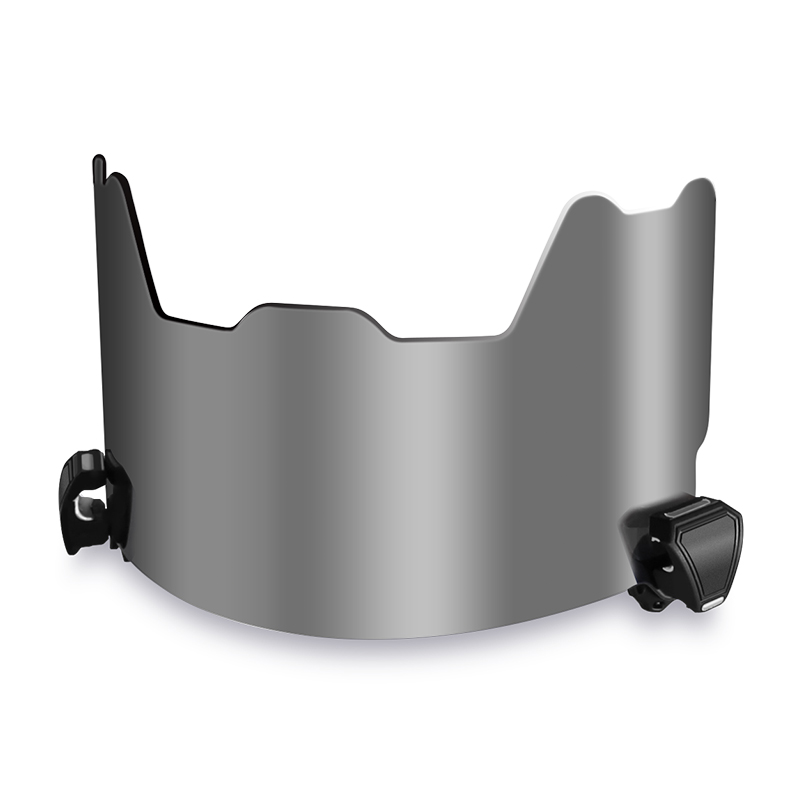
Premium brands refuse to compromise. They employ a two-sided strategy to achieve comprehensive protection. They apply a rigid hard-coat to the convex (outer) surface. Simultaneously, they apply a hydrophilic moisture-absorbing coat to the concave (inner) surface. This creates the optimal sports protective visor. The outside deflects flying rocks and branches, while the inside manages heavy exhales and facial heat.
Implementation realities vary depending on factory capabilities. Factories commonly use dip coating, flow coating, or spin coating to apply the chemicals. Dip coating submerges the entire lens, requiring complex masking to keep the hard coat off the inner surface. Flow coating gently pours the chemical over a tilted shield, offering better control per side. These methods carry substantial cost implications. Multi-stage curing lines require massive floor space, strict dust control, and high energy consumption.
Some brands evaluate secondary solutions to avoid chemical inner-coatings altogether. Pinlock inserts are incredibly popular in motorcycling. A Pinlock creates a sealed, dual-pane thermal barrier using a secondary silicone-edged lens. Dual-pane thermal lenses work similarly for snow goggles. They physically separate the cold outside air from the warm inside air, naturally preventing condensation without relying heavily on soft chemical layers.
Any dual-coating endeavor requires a strict risk assessment. Poorly applied chemicals carry a high potential for delamination. Extreme temperatures can cause the coatings to peel away from the base plastic. Prolonged sun exposure leads to UV degradation, turning clear layers yellow. Furthermore, if a factory applies liquid coatings unevenly, the resulting thickness variations cause severe optical distortion.
You cannot blindly select surface treatments without studying your target demographic. The specific sport dictates the required chemical balance.
High-velocity, debris-heavy sports demand specific protections. Motorsports, downhill mountain biking, and track cycling subject the athlete to intense wind and flying particulate matter. Exertion remains relatively stable, meaning internal body heat spikes less drastically. Here, you must bias heavily toward premium anti-scratch. The outer shell takes relentless abuse from roost, bugs, and gravel.
Conversely, high-exertion, cold-weather sports present a totally different reality. Skiing, snowboarding, and ice hockey involve massive cardiovascular output in freezing environments. The athlete dumps incredible amounts of body heat and moisture into the helmet interior. In these scenarios, you must bias heavily toward maximum-capacity anti-fog. A scratched hockey shield is annoying, but a fogged hockey shield is actively dangerous.
You must ensure your chosen chemicals do not interfere with mandatory safety testing. Certifications like ANSI Z87.1 (occupational), EN 166 (European eye protection), and Snell (helmet safety) require rigorous impact and optical tests. Certain aggressive hard coats can make the underlying plastic too brittle, causing the shield to shatter during high-velocity ballistics testing. Likewise, thick anti-fog layers might accidentally drop the luminous transmittance below the legal minimums for night riding.
Financial allocation plays a massive role in product development. Balancing the manufacturing cost of advanced UV-cured dual coatings against target retail price points is difficult. A premium dual-coated shield might cost three times as much to produce as a single-coated alternative. You must decide if your brand positioning allows you to pass this premium onto the consumer. Mid-tier products often compromise by using a cheaper surfactant-based anti-fog dip rather than a permanent hydrophilic cure.
Taking a product from concept to mass production requires strict validation. Product managers must define rigid performance thresholds before signing purchase orders.
You must set acceptable failure thresholds. Do not accept vague promises from OEM partners. Demand precise metrics. For example, determine exactly how many seconds the shield can hover over 50°C steam before fogging occurs. Industry-leading hydrophilic coatings can last over 30 seconds before condensing. For scratch resistance, mandate specific steel wool abrasion parameters. Specify the load weight (e.g., 500 grams) and the number of continuous rubs before hazing appears.
Never test fully assembled helmets first. Request raw, unmounted visors from your OEM partners. Place these standalone samples into environmental testing chambers. Subject them to extreme cold (-20°C) and immediately transition them to high humidity (80% RH at 30°C). This rapid cycling exposes weak adhesion and guarantees the layers will not delaminate during actual winter usage.
Engineering the perfect product means nothing if the consumer destroys it on day one. Brands must include strict, highly visible care instructions. Post-purchase education prevents users from accidentally stripping factory coatings. Consumers frequently grab harsh, ammonia-based glass cleaners to wipe their gear. Ammonia violently breaks down hydrophilic polymers. You must instruct buyers to use only mild soap, warm water, and clean microfiber cloths. Inform them that wiping the inside layer while it is saturated with moisture will permanently tear the soft anti-fog sponge layer.
Sports brands shouldn't view the division between moisture management and abrasion resistance as a binary choice. Instead, approach it as a strategic allocation of manufacturing resources. Base materials require robust enhancement to survive the rigors of athletic competition. By understanding the chemical limitations of both treatments, you can design products tailored to your exact sporting environment.
For a flagship release, invest heavily in dual-sided, permanent factory coatings. The upfront cost protects your brand reputation and drastically lowers return rates. For entry-level models, prioritize exterior anti-scratch treatments. You can offset the lack of chemical inner-coatings by designing superior mechanical ventilation systems into the helmet shell to naturally mitigate condensation. Ultimately, testing rigorously and educating your consumer will ensure your gear performs flawlessly on the field.
A: No. While anti-scratch coatings can last the lifetime of the helmet under normal conditions, hydrophilic anti-fog coatings naturally degrade over time and through repeated washing.
A: Yes, on the surface it is applied to. Anti-fog chemicals create a softer, microscopic "sponge" layer, making that specific side more susceptible to micro-abrasions if wiped dry.
A: Aftermarket sprays require constant reapplication, offer inconsistent optical clarity, and fail to meet the "out-of-the-box" readiness expected by premium sports gear consumers.

