

- Home
- Products
- HOT
- Technology
- Service
- Resources
- About
- Contact
- All
- Product Name
- Product Keyword
- Product Model
- Product Summary
- Product Description
- Multi Field Search

Views: 0 Author: Site Editor Publish Time: 2026-06-22 Origin: Site


Defending the net requires extreme courage. Your field hockey goalie helmet serves as your most critical piece of defensive equipment. You regularly face ball speeds exceeding 70 mph. Absolute head protection must remain your first priority on the pitch.
Buyers constantly wrestle over a specific tension. You want to maximize impact defense. At the same time, you cannot compromise peripheral vision, essential breathability, or quick neck mobility. A heavy shell stops blunt force but quickly drains your energy. Poor cage designs block your line of sight during critical saves.
We provide a transparent, criteria-based framework below. You will use it to evaluate, size, and select optimal protective headgear. We map out safety standards and verifiable material differences. You will learn to match specific helmet features directly to your current level of play.
Field hockey goalie helmets are engineered specifically for the size and density of a field hockey ball, making cross-sport alternatives (like ice hockey or lacrosse helmets) potentially unsafe.
Evaluation comes down to three structural components: shell material (ABS vs. fiberglass/carbon), cage design (visibility vs. regulation gaps), and internal foam density (impact absorption).
Proper fit is non-negotiable; a premium helmet fitted poorly offers less protection than a properly sized mid-tier model.
Used helmets carry hidden risks—internal foams degrade and harden over time, compromising impact resistance regardless of external appearance.
Understanding helmet anatomy helps you make informed purchasing decisions. Each component plays a specific role in absorbing kinetic energy. Manufacturers carefully engineer these elements to work together as a unified safety system.
The rigid outer layer acts as your first line of defense. It disperses initial impact energy across a wider surface area. Standard entry-level models feature injection-molded ABS plastics. These plastics offer durable, cost-effective protection for youth leagues. Elite models utilize advanced fiberglass and Kevlar composites. These aerospace-grade materials reduce weight significantly. They maintain exceptional structural integrity against high-velocity drag flicks.
The cage protects your face while maintaining visibility. Manufacturers construct these wire configurations from high-tensile carbon steel or titanium. Gap sizing undergoes strict regulation. The design must prevent a standard field hockey ball from penetrating the mask. You rely on these precise grid layouts to track the ball during chaotic penalty corners.
Closed-cell foam inserts line the interior of the shell. They serve a vital dual purpose. First, they absorb the blunt force trauma passing through the outer shell. Second, they ensure a customized fit. High-quality foams contour to your specific head shape. They prevent independent shifting when you dive for a save.
The backplate protects the vulnerable occipital region of your skull. A five-point strapping system secures this plate to the main shell. You adjust these heavy-elastic straps to dial in your precise fit. A robust harness maintains helmet stability. It anchors the unit firmly during aggressive lateral movements.
Selecting protective gear requires analyzing multiple variables. You must balance impact resistance against overall weight. You also need to consider visibility and airflow. We break down the primary evaluation metrics below.
Weight directly impacts your reaction time and neck fatigue. Entry-level ABS plastic shells weigh more. They provide excellent protection for youth players facing sub-50 mph shots. High-end carbon and fiberglass blends feel remarkably lighter. Elite players demand these composite models. They reduce muscular strain during long tournaments while withstanding professional-level shot velocities.
Material Type | Weight Profile | Ideal Level of Play | Impact Resistance |
|---|---|---|---|
ABS Plastic | Heavier | Youth / Beginner | Moderate (Sub-50 mph) |
Fiberglass Blend | Medium | High School / Club | High (50-70 mph) |
Carbon / Kevlar | Ultra-Light | College / Elite | Extreme (70+ mph) |
Goalkeepers need maximum peripheral vision. You must read the offensive formation instantly. Standard grid cages use uniformly spaced vertical and horizontal wires. They offer universally accepted safety. Alternatively, "cat-eye" cages feature specialized scalloped wire cutouts near the eyes. They improve forward visibility dramatically.
Note on Compliance: Specific cat-eye configurations face strict regulations. Some youth leagues ban extreme cat-eye designs completely. A stick toe can penetrate oversized wire gaps during a goalmouth scramble. Always verify your specific league rules before purchasing a cat-eye model.
Internal foams dictate your comfort and safety. Manufacturers use single-density or dual-density configurations. Single-density foam offers uniform cushioning. It suits younger players perfectly. Dual-density foam combines a rigid outer impact layer alongside a softer inner comfort layer. Dual-density systems manage both low-impact bumps and high-velocity strikes effectively. They represent a mandatory upgrade for competitive high school athletes.
Player fatigue ruins performance. Goalkeepers wear heavy protective gear during peak summer heat. Strategic shell cutouts prevent severe overheating. Better ventilation channels pull cool air through the front mask. They expel trapped hot air out the backplate. Proper airflow keeps your core temperature stable during intense tournament weekends.
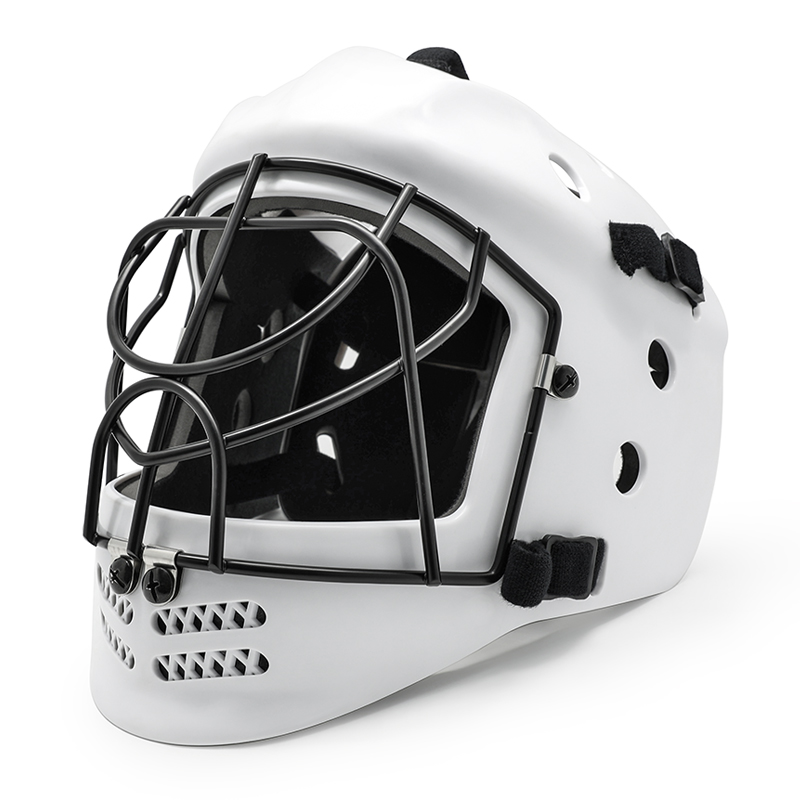
A premium field hockey helmet offers zero advantage if it fits poorly. Sizing represents the most crucial step in your purchasing journey. You must treat proper fit as an absolute non-negotiable factor.
Parents often buy oversized gear to save money. We explicitly warn parents and program directors against this practice. You should never buy an oversized helmet for a youth player. A loose fit creates dangerous secondary impact zones. The shell accelerates before hitting the skull during a collision. Furthermore, an oversized cage drops below the brow line. It severely blocks the player's vision.
Follow strict measurement protocols to find your baseline size. Do not guess your head circumference.
Take a soft, flexible tailor's tape measure.
Wrap the tape around the head horizontally.
Rest the tape approximately one inch above the eyebrows.
Ensure the tape passes over the widest part of the back of the head.
Record the measurement in both inches and centimeters.
Map this exact number directly to the manufacturer's specific sizing chart.
You must perform a physical test to confirm the final fit. We call this the Shake Test. Put the helmet on and secure the backplate harness. Vigorously shake your head up, down, left, and right. The user's skin should move simultaneously with the interior foam. You should feel zero independent shifting. If the shell rattles or slides over your forehead, you need a smaller size.
Your headgear does not exist in a vacuum. It must interact smoothly with your throat guard and chest protector. Put on your upper body gear. Look down toward your feet. The chin cup and bottom cage wire must not jam into your chest plate. Limited downward neck mobility prevents you from seeing the ball near your kickers.
Goalkeeping equipment requires a significant financial investment. Many buyers explore the used market to stretch their budgets. You must understand the hidden dangers of second-hand protective gear before buying.
Safety equipment carries a hidden expiration date. Closed-cell EVA and EPP foams degrade naturally. They harden, compress, and lose their kinetic absorption properties over 3 to 5 years. This chemical degradation happens even without visible exterior damage. A five-year-old used helmet might look pristine on the outside. However, the hardened interior foam will transfer impact energy directly to your skull.
Previous owners rarely disclose the full impact history of a used item. High-velocity strikes create hairline shell fractures. These microscopic cracks compromise the structural integrity of the entire shell. You easily miss them during a casual visual inspection. One more direct hit could shatter the compromised plastic entirely.
You must frame the financial decision around safety priorities. Total budgets are often constrained. We strongly recommend prioritizing your budget for a new, properly fitted helmet. You can safely buy used leg guards or kickers if necessary. You cannot compromise on brain protection. Allocate your largest budget percentage to your headgear.
You now understand the structural components and evaluation criteria. You need a practical strategy to shortlist the right models based on your specific playing environment.
Prioritize lightweight ABS plastic models.
Look for maximum harness adjustability to accommodate slight growth during a single season.
Select standard grid cages strictly to guarantee league compliance and ultimate safety.
Transition away from basic single-density padding.
Select dual-density foam interiors to manage elevated shot speeds.
Choose stronger fiberglass composite shells. You need them to handle advanced drag flicks and aggressive forward strikes.
Invest heavily in custom-fitted interiors.
Demand carbon-Kevlar blends to secure the maximum protection-to-weight ratio.
Evaluate certified cat-eye wire configurations to achieve optimal peripheral vision during high-speed elite play.
Your next step requires immediate action. Grab a flexible tape measure right now. Measure your exact head circumference using our protocol above. Check your specific league safety mandates regarding cage designs. Only then should you begin browsing retailer categories for your perfect fit.
A: No. While they look similar superficially, ice hockey cages are designed specifically to stop a flat puck. A round field hockey ball can potentially lodge in or penetrate certain ice hockey cages. Furthermore, the overall impact profiles differ greatly between the two sports.
A: You should typically replace it every 3 to 5 years depending on usage frequency. However, you must replace it immediately if the outer shell cracks, the wire cage bends, or the interior foam hardens and flakes.
A: Extreme cat-eye designs feature widened gaps near the eyes. These gaps are often wide enough for the toe of a field hockey stick to penetrate during a scramble. This severe risk leads to strict regulations by governing bodies like the NFHS and FIH.
A: Wipe down the outer shell regularly using mild soap and a damp cloth. Always air dry the interior foam out of direct sunlight to prevent rapid UV degradation. Routinely check the backplate harness screws for rust or loosening.


