

- Home
- Products
- HOT
- Technology
- Service
- Resources
- About
- Contact
- All
- Product Name
- Product Keyword
- Product Model
- Product Summary
- Product Description
- Multi Field Search

Views: 0 Author: Site Editor Publish Time: 2026-06-24 Origin: Site


An improperly fitted field hockey goalie helmet compromises your safety and limits your peripheral vision on the pitch. Standard hat sizes often mislead buyers during the decision stage. Guessing your size routinely causes high return rates. It also creates critical vulnerabilities during intense gameplay. Head shapes dictate a proper fit equally as much as raw circumference measurements. If a helmet shifts during a rapid dive, it fails entirely. If the internal padding pinches your temples, it destroys your athletic focus. This guide provides an evidence-based framework for precise measuring. You will learn how to evaluate complex brand fit charts accurately. We also teach you how to validate the final physical fit at home. Following these steps ensures a secure, rule-compliant purchase for ultimate protection.
Helmet sizing requires a soft measuring tape and exact millimeter/inch circumferences; standard hat sizes are insufficient baselines.
Brand sizing charts vary significantly; a "Medium" in one brand may map to a "Large" in another due to different internal foam configurations.
Never size up a junior field hockey goalie helmet to accommodate future growth; the safety risks of a loose shell far outweigh the cost of replacement.
The physical "Fit Test"—evaluating chin cup placement, backplate overlap, and the shake test—is mandatory before finalizing the purchase.
A properly fitted helmet does more than block shots. It acts as a cohesive safety system. You must evaluate four core areas before trusting any piece of headgear. These criteria ensure peak performance and maximum injury prevention.
The foam liner must maintain continuous contact across your forehead, temples, and cheeks. This seamless contact absorbs high-velocity ball impacts efficiently. Gap space concentrates force into isolated zones. Concentrated force increases the risk of head injuries significantly. Continuous contact spreads the kinetic energy safely across the entire outer shell.
The helmet cage must align perfectly across your natural eye line. You should never need to tilt your head unnaturally to see the ball. Poor visual clarity delays reaction times. A correct fit ensures you track drag flicks seamlessly through heavy traffic. Proper cage alignment helps maintain an upright, balanced athletic posture.
Goalkeeping requires explosive lateral movements. The helmet must not shift vertically during aggressive kick saves. It cannot rotate laterally during rapid dives. Rotational instability blinds the goalie momentarily. A stable helmet stays locked in place regardless of sudden directional changes.
Equipment must sit exactly as manufacturers designed it. Proper positioning meets strict safety standards set by the International Hockey Federation (FIH). Local leagues also enforce these rigorous safety benchmarks. An ill-fitting helmet essentially voids manufacturer safety certifications. Compliant gear guarantees standard protection levels during official matches.
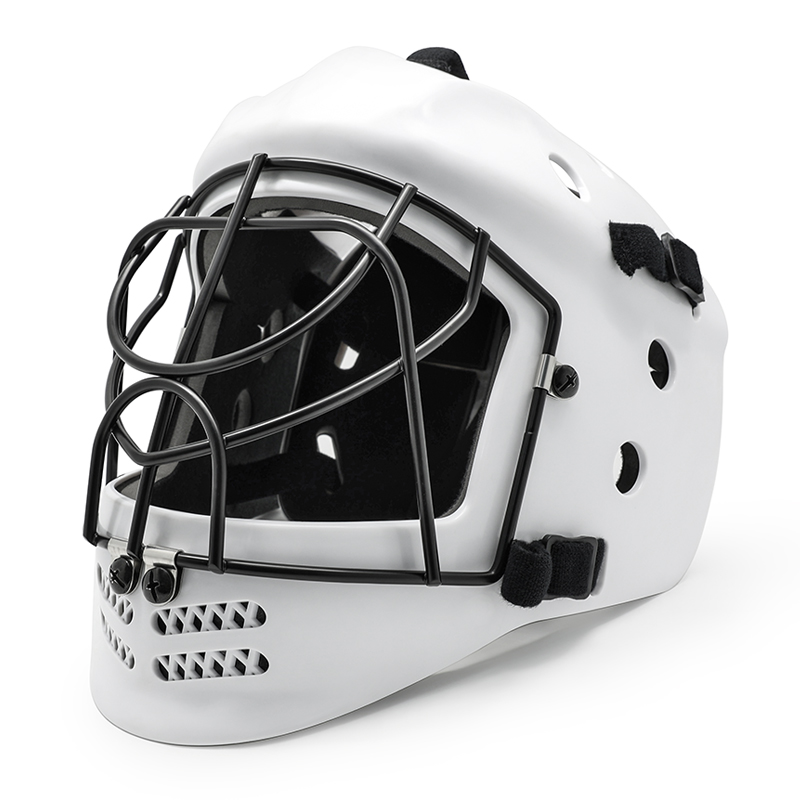
Accurate measurements dictate your buying success. You cannot rely on standard baseball cap sizing. Follow this exact methodology to gather your baseline data.
You must use a flexible cloth measuring tape. Tailors use these exact soft tapes daily. Rigid metal tapes distort the measurement curve entirely. Metal tapes cannot wrap snugly around your skull contours. If you lack a cloth tape, use a piece of non-stretch string. Mark the string and measure it flat against a standard ruler.
Measuring the circumference establishes your core sizing metric. Follow these specific steps carefully:
Place the soft tape approximately one inch (2.5 cm) above the eyebrows.
Wrap the tape horizontally around the widest part of the back of the head.
Keep the measuring line perfectly level across the sides.
Pull the tape snug against the hair. Do not compress the skin painfully.
Raw numbers only tell half the story. Head shape determines which brands will sit correctly. Observe the general shape of the player's head from above.
Oval Shapes: These heads measure narrow side-to-side but longer front-to-back.
Round Shapes: These heads measure more uniformly across all dimensions.
Identifying this shape prevents painful pressure points later. A round head placed inside an oval-molded shell suffers severe temple pinching. An oval head in a round shell experiences lateral sliding.
Record your final measurements in both centimeters and inches. European manufacturers typically utilize centimeters as their primary metric. North American brands often default to inches. Having both numbers ready speeds up your comparison process. Accurate data eliminates guesswork when browsing online equipment catalogs.
Fitting a young player requires strict safety boundaries. Parents naturally want gear to last multiple seasons. However, head protection leaves absolutely no room for budget-driven compromises.
Buying a larger helmet to extend its lifespan introduces critical failure points. This mistake happens frequently in youth sports. A loose helmet slides down over the eyes easily. It can also rotate sideways upon impact. This rotation exposes the vulnerable back of the head to incoming shots. Never size up a junior field hockey goalie gear setup expecting future growth.
Junior helmets are not merely scaled-down adult helmets. Manufacturers design youth gear using entirely different physical parameters. They feature much lighter shell materials. Lighter materials prevent severe neck fatigue for younger players. The internal molds also feature distinct chin-to-forehead ratios. These specific ratios accommodate younger, developing bone structures safely.
Players eventually reach the exact threshold between a Youth Large and an Adult Small. This transition period confuses many buyers. Always prioritize the size offering the most flush contact across the cheeks and temples. Do not choose the option providing the most strap slack. Flush contact guarantees impact energy dissipates correctly. Extra strap length cannot fix a fundamentally loose internal shell.
Sizing charts provide a starting point. They are never an absolute guarantee. You must cross-reference your measurements against specific brand matrices. Different companies utilize entirely different internal molds.
Dominant field hockey brands like OBO, TK, and Grays use proprietary shell designs. A "Medium" from one manufacturer routinely maps to a "Large" from another competitor. You must acknowledge these industry inconsistencies immediately. Never assume your size transfers evenly across different brands. Always consult the specific chart for the exact model you want.
Brand Sizing Matrix Discrepancy Chart (Example Data) | |||
Measurement (cm) | Brand Alpha Fits | Brand Beta Fits | Internal Mold Type |
|---|---|---|---|
53 - 54 cm | Small | Medium | Narrow / Oval |
55 - 56 cm | Medium | Large | Standard / Round |
57 - 58 cm | Large | Extra Large | Wide |
Internal padding materials vary wildly between models. Some helmets utilize advanced dual-density foams. These foams compress slightly over the first few weeks of use. This compression represents a standard break-in period. Other models use highly rigid foams. Rigid foams maintain their exact out-of-the-box dimensions indefinitely. Ask retailers about the specific foam type before completing your transaction.
Match your recorded circumference directly to the brand's sizing chart. Sometimes, your measurement falls exactly on the border of two distinct sizes. When this happens, default to the smaller size. A smaller size ensures a tighter, safer initial fit. However, this rule only applies if the smaller size does not cause immediate pressure headaches. Severe pain indicates you need a different brand entirely.
You received your new equipment in the mail. Now, you must perform a rigorous physical validation before removing any tags. This testing phase separates a functional purchase from a dangerous one.
Place the helmet on your head and secure the straps lightly. The interior should rest comfortably atop the crown. Inspect the perimeter carefully in a mirror. You should see zero visible gaps between the internal padding and your forehead. The side foams must press evenly against both temples. They should never cause throbbing pain or restrict blood flow.
The five-point harness controls the rear backplate. This backplate must overlap the main shell slightly. If the backplate sinks completely inside the shell edge, the helmet is too small. Conversely, check the harness strap tension. If you pull the straps to their absolute maximum limit and the shell remains loose, the helmet is too large.
The chin cup anchors the entire facial structure safely. The goalie's chin must sit securely inside this designated cup. A properly seated chin prevents the mask from riding up during collisions. If the mask rides up, it exposes the vulnerable throat area directly to the ball. Adjust the lower straps until the chin locks into place securely.
This final step validates the overall rotational stability. Secure all straps to their final playing tension. Have the wearer aggressively shake their head up and down. Next, shake the head rapidly left and right. The cage must track perfectly alongside the eyes. If the cage shifts independently of the head movement, the fit fails entirely. Return the product immediately and evaluate a different model.
A successful equipment purchase protects your brain and enhances your reaction times. Follow these specific steps to secure the perfect fit.
Measure precisely: Always use a soft cloth tape to record exact centimeter and inch circumferences.
Analyze head shape: Match your naturally oval or round head shape to the correct proprietary brand mold.
Prioritize flush contact: Ensure zero gaps exist between the internal foam liner and your forehead.
Validate physically: Perform the rigorous shake test and check the backplate overlap before stepping onto the pitch.
Your next step requires gathering a soft measuring tape today. Record your baseline numbers carefully. Consult your target brand's specific sizing chart online. Order the most accurate size based on your exact data. Leave all factory tags on the gear until you complete the rigorous 4-point physical fit test at home.
A: No. While visually similar, field hockey and ice hockey helmets serve entirely different purposes. They have vastly different impact ratings. The cage designs address different ball and puck sizes. Manufacturers use proprietary sizing matrices for each sport. Always use sport-specific brand charts to ensure maximum safety and league compliance.
A: Temple pressure indicates a severe shape mismatch. The helmet shell is clearly too narrow for your natural head shape. You need to evaluate a different brand utilizing a wider, rounder internal mold. Do not simply size up in the same model. Sizing up creates dangerous gaps across your forehead and cheeks.
A: Start your fitting process leaving all straps entirely loose. Tighten the top straps first. This sets the proper vertical height for your eye line. Next, adjust the side and bottom straps evenly. This secures the required horizontal tension. The backplate should remain perfectly centered on the back of your head.


