

- Home
- Products
- HOT
- Technology
- Service
- Resources
- About
- Contact
- All
- Product Name
- Product Keyword
- Product Model
- Product Summary
- Product Description
- Multi Field Search

Views: 0 Author: Site Editor Publish Time: 2026-06-27 Origin: Site


Defensive play in modern sports demands serious courage and precise preparation. Ball speeds during defensive penalty corners regularly surpass safe human reaction thresholds. This sheer velocity makes proper facial protection a non-negotiable risk management tool. Players and athletic programs face a constant balancing act. They must secure maximum facial safety while preserving crucial peripheral vision. Defenders also need gear they can remove instantly to maintain strict league compliance.
Navigating these overlapping demands can feel overwhelming for coaches and athletes alike. This guide breaks down exactly when and why players deploy these specialized shields on the pitch. We will explore the vital regulatory standards governing them. Finally, you will learn how to accurately evaluate a field hockey face mask to keep your defensive units safe and confident during high-stakes game scenarios.
Field players exclusively use face masks during defensive penalty corners and must remove them immediately after the play clears.
A compliant field hockey protective mask prioritizes impact absorption (polycarbonate/cushioning) without presenting hard, dangerous edges to opposing players.
Purchasing decisions must align with specific governing body rules (FIH, NFHS) regarding color, material, and coverage.
Goaltender helmets and field player face masks are entirely different categories of equipment with different compliance standards.
The penalty corner, often called a short corner, represents the most dangerous phase of game play. Attacking teams use this setup to unleash powerful shots directly at the goal. Defenders must rush a drag-flicker who is striking a hard ball at exceptionally close range. The proximity between the striker and the rushing defenders leaves almost zero margin for error. A defender essentially acts as a human shield to block the incoming trajectory.
Clinical sports injury data consistently points to the face and head as high-risk zones during these plays. Stick follow-throughs swing high into the air. Elevated ball trajectories routinely threaten players stationed on the goal line. We see evidence in sports medicine journals highlighting the severity of these impacts. Without proper shielding, a solid composite stick or a dense plastic ball can cause catastrophic damage in a fraction of a second.
These specialized shields deliver highly targeted protection. They mitigate severe lacerations, prevent devastating dental trauma, and guard against shattered orbital fractures. High-density materials absorb the brunt of a localized strike. However, buyers must understand inherent limitations. A mask cannot guarantee complete concussion prevention. It significantly reduces localized facial damage, but it cannot stop the brain from moving inside the skull during a massive rotational force impact.
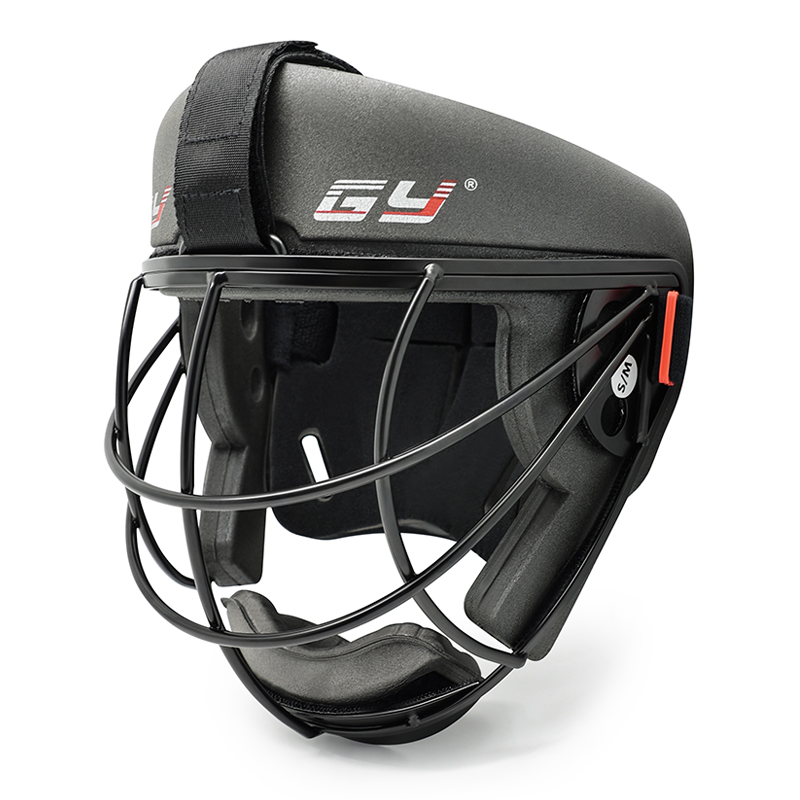
Understanding equipment categories is crucial for player safety and rule compliance. A common mistake involves confusing goalie helmets for field gear. Their design intents differ drastically based on usage duration. Goalkeepers wear full-coverage helmets for the entire match. They need continuous, heavy-duty shielding. Field players wear minimalist masks for brief 10-to-20-second bursts during specific defensive plays.
The structural differences between these two items are massive. Goalkeeper helmets utilize heavy-duty composite materials or rigid carbon fiber. They feature full metal wire cages for maximum visual shielding. They also include integrated throat protectors. Conversely, a field hockey protective mask prioritizes agility. Manufacturers mold them from lightweight, transparent polycarbonate or smooth plastics. They feature an open back and rely on quick-release strapping systems.
We can summarize these structural differences in a simple comparison matrix:
Feature | Goalkeeper Helmet | Field Player Mask |
|---|---|---|
Usage Duration | Full match continuous wear | 10-20 seconds per penalty corner |
Primary Material | Carbon fiber, heavy composite | Lightweight polycarbonate, smooth plastic |
Face Shielding | Full metal wire cage | Clear molded plastic, wide eye cutouts |
Neck/Throat Protection | Integrated or attachable guard | None (open bottom design) |
Removal Mechanism | Complex buckles, secure fit | Quick-release elastic straps |
This matrix clarifies a firm purchasing boundary. Buyers looking to outfit a field player cannot substitute a goalie helmet. You also cannot use a standard lacrosse or ice hockey cage. Governing bodies strictly ban those alternatives for field defenders due to collision risks.
You must understand the operational reality of the removal rule. Governing bodies dictate precise timelines for wearing defensive gear. Players incur severe penalties if they continue playing while masked outside the 23-meter area after the corner clears. Officials enforce this aggressively. The equipment exists solely for the penalty corner phase. Once the immediate threat passes, players must discard the shield and resume normal play.
Material and shape constraints dictate product designs heavily. Metal cages are generally banned for field players. A metal cage poses a severe hazard. If a masked defender collides with an unmasked opponent, protruding metal wires can cause terrible injuries. To prevent this, regulations mandate smooth surfaces. Masks must sit flush against the face. They cannot feature sharp angles or hard exterior hardware.
Color compliance adds another layer of regulatory scrutiny. Many leagues, including the International Hockey Federation (FIH), enforce strict color codes. They require clear, white, or dark-colored options. Officials restrict heavily mirrored lenses. They also ban high-visibility neon colors. These bold designs distract opponents and disrupt the visual flow of the game.
Medical exemptions exist, but they remain rare and strictly controlled. A player might receive permission to wear a modified shield during general play. This usually happens when a player is recovering from a broken nose or facial surgery. However, this requires specific umpire approval before the match begins. You must provide documented medical clearance. The umpire will physically inspect the item to ensure it harms no one else.
Selecting the right safety gear requires methodical evaluation. You cannot base decisions purely on team colors or budget. Coaches and athletes should prioritize the following four criteria when evaluating their options.
Impact Absorption: You must evaluate the interior high-density foam cushioning. Foam thickness dictates shock distribution across the forehead and cheekbones. Superior EVA foam compresses upon impact. It dissipates kinetic energy away from fragile facial bones. Press your thumb into the foam before purchasing. It should feel dense, not spongy.
Visual Field Clarity: Assess the eye opening dimensions carefully. A mask must provide excellent downward visibility. Defenders must track the ball constantly. However, oversized eye holes compromise orbital bone protection. A well-designed shield balances these needs. It allows wide peripheral vision while keeping plastic barriers close to the eyes.
Strap Mechanics and Scalability: Evaluate the retention system rigorously. The strapping must survive a direct, high-speed hit without flying off. Yet, it must remain loose enough for a player to rip off one-handed. Defenders often pull the gear off while sprinting upfield to launch a counter-attack. Look for thick, high-quality elastic bands. Test the velcro for long-term durability.
Durability vs. Replacement: High-impact plastics inevitably degrade. Repeated strikes weaken the molecular structure of polycarbonate. Prolonged UV exposure from playing in direct sunlight causes the plastic to become brittle. Outline a strict framework for retirement. Replace any gear showing hairline fractures immediately. Routinely inspect the foam adhesive, as sweat breaks it down over a single season.
Best Practice: Always prioritize function over aesthetics. A slightly heavier shield with superior foam will always outperform a sleek, poorly padded alternative during a direct impact.
Purchasing the gear is only the first step. You must manage the physical realities of wearing polycarbonate shields on a hot field. Address the "fog and sweat" factor immediately. Players breathe heavily during high-stress defensive plays. Clear plastic fogs up instantly. Evaluate ventilation cutouts closely. Quality designs feature strategic air vents near the mouth and nose. These vents direct hot air away from the eyes. Many players also apply anti-fog sprays to the interior lens before matches.
Transition training remains a critical, often overlooked element. Teams must practice the physical routine of dropping the shield safely. You cannot just throw it anywhere. Players must toss it safely out of the field of play, usually over the endline. Doing this during a live counter-attack requires intense muscle memory. Coaches should run specific drills where players defend a corner, strip their gear, and sprint into an attacking formation simultaneously.
Sizing limitations present significant safety hurdles. The "one-size-fits-most" label is common across manufacturers. Unfortunately, poorly fitted equipment dramatically reduces safety efficacy. If the shield slides down upon impact, it can break the nose it was supposed to protect. Highlight the importance of testing fit properly.
Test the fit over the player's actual mouthguard.
Ensure the chin rests securely in the bottom cup.
Check that the forehead foam sits flush against the skin.
Shake the head vigorously to test strap tension.
Common Mistake: Never let players share this specific equipment during a game. Sweat degrades the interior foam. Constant readjustment of the straps ruins the elastic tension. Each defender needs their own perfectly fitted shield.
Providing optimal safety for defensive units requires specialized knowledge and strict adherence to protocol. A field hockey face mask is a highly specialized, situational piece of protective equipment. It is never meant to serve as a general-use accessory. Its design caters explicitly to the violent, high-speed reality of the short corner.
As you prepare your team for the season, prioritize these actionable next steps. First, verify your local league's current-year equipment handbook before finalizing any purchase. Rules regarding colors and materials update frequently. Second, prioritize models with proven impact-absorption ratings over attractive aesthetic designs. Finally, integrate quick-removal drills into your weekly practice schedules. Proper gear combined with proper training ensures your defenders remain safe, compliant, and ready to dominate the pitch.
A: No, except under strict, medically documented exemptions approved by the match umpire. Standard rules require players to remove them immediately after the penalty corner clears the 23-meter area.
A: They reduce localized impact forces, but no mask eliminates concussion risk from rotational forces. They primarily prevent lacerations, broken noses, and severe dental trauma.
A: No. They violate FIH/NFHS rules for field players due to metal cages and protruding edges. These features pose severe injury risks to other players during collisions.
A: Use non-abrasive soap, warm water, and a soft microfiber cloth. This prevents micro-scratches that impede vision. Avoid harsh chemical cleaners, as they degrade the plastic and weaken impact resistance.


