

- Home
- Products
- HOT
- Technology
- Service
- Resources
- About
- Contact
- All
- Product Name
- Product Keyword
- Product Model
- Product Summary
- Product Description
- Multi Field Search

Views: 0 Author: Site Editor Publish Time: 2026-07-01 Origin: Site


Penalty corners present distinct physical risks on the pitch. Elite drag flicks frequently exceed 60 to 80 mph at incredibly close range. Defenders rushing the striker face a literal firing squad of dense, hard plastic.
Treating a face shield as a generic accessory creates dangerous vulnerabilities. A low-quality shield fails to absorb severe kinetic energy. This failure risks catastrophic orbital fractures or severe dental trauma. Players need specialized safety equipment built specifically to withstand high-velocity blunt force. Standard sports goggles simply cannot handle these extreme impacts.
We provide an evidence-based evaluation framework below. You will discover how to assess these critical defenses properly. We help players, parents, and coaches confidently distinguish high-performance protective gear from inadequate alternatives. Read on to master the essential safety features required for modern field hockey.
Material matters most: True protection requires an impact resistant face mask built from high-density polycarbonate or specialized wire alloys, not standard plastics.
Fit dictates function: A mask with inferior foam padding or a weak retention system will shift upon impact, transferring kinetic energy to the face.
Visibility is a safety feature: Maximum protection must not severely compromise peripheral vision or downward sightlines required for ball tracking.
Compliance is non-negotiable: Any shortlisted mask must meet current FIH (International Hockey Federation) safety guidelines.
Defending a penalty corner represents the single most dangerous play in field hockey. We must clearly define the primary use case for this equipment. Players strictly wear these protective shields while defending penalty corners. They must remove them immediately after the play ends. Understanding this specific context helps us evaluate what makes a shield truly effective.
To evaluate effectiveness, we look for three non-negotiable success criteria. If a piece of equipment fails any of these benchmarks, it belongs off the field.
Blunt Force Dispersion: The rigid outer shell must instantly absorb and spread the kinetic energy of a fast-moving ball.
Dynamic Stability: The harness must remain completely secure while a defender sprints at top speed toward the shooter.
Rapid Removal Mechanics: The player must discard the shield in less than a second to safely resume normal field play.
Wearing non-specialized or inadequate gear carries severe physical costs. An inferior shell may shatter upon impact. Shrapnel poses an immediate threat to the eyes. Additionally, poorly designed equipment directly causes psychological hesitation. Defenders flinch when they do not trust their gear. Flinching delays reaction times during critical defensive rushes. A split-second delay often means the difference between a blocked shot and a dangerous body strike. You must prioritize specialized construction to prevent devastating injuries like shattered cheekbones or concussions.
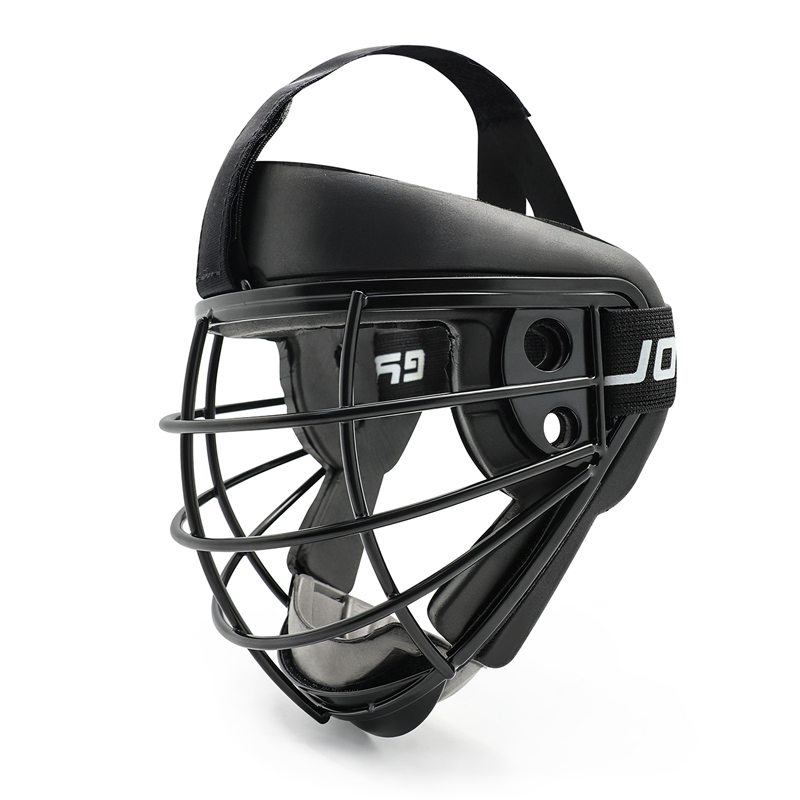
Manufacturers generally rely on two dominant material categories to construct an impact resistant face mask. You must choose between clear polycarbonate polymers and metal wire frames. Each material offers distinct advantages and specific operational trade-offs.
Clear polycarbonate delivers exceptional optical freedom. Defenders enjoy unobstructed views of the entire penalty circle. This material provides complete, unbroken facial coverage. The seamless barrier prevents stray stick deflections from reaching the eyes. However, polycarbonate requires dedicated maintenance. It remains highly susceptible to fogging during cold evening matches. The surface also accumulates micro-scratches over time if you clean it improperly.
Conversely, wire or steel grills prioritize maximum breathability. Metal frames boast incredible structural rigidity. They shrug off repeated high-velocity impacts without structural degradation. Rain and condensation never obscure a wire grill. Yet, the grid structure creates a slight visual obstruction. Players must mentally adjust to looking through the metal bars.
Comparison Chart: Core Mask Materials | |||
Material Type | Primary Advantage | Primary Drawback | Best Weather Condition |
|---|---|---|---|
Clear Polycarbonate | Unobstructed field of view | Prone to fogging/scratching | Dry, mild climates |
Steel/Wire Grill | Maximum breathability/durability | Slight visual grid obstruction | Humid, rainy, or freezing conditions |
Top-tier equipment utilizes advanced geometry to manage kinetic energy. When a solid ball strikes the shield, localized force threatens the skull. A well-engineered outer shell acts like a rigid trampoline. It captures the initial localized strike. The shell then instantly distributes that energy outward across a much wider surface area. This rapid dispersion prevents the force from concentrating on delicate facial bones.
Common Mistakes: Never purchase cheap alternatives made from low-grade acrylics. Some manufacturers use brittle standard plastics to cut production costs. These inferior materials cannot withstand a direct 70 mph strike. They will catastrophically shatter. Look exclusively for "high-density polycarbonate" or "tempered steel alloys" when reviewing product specifications.
Even the strongest outer shell fails if the interior padding collapses. Fit stability directly determines how well the equipment protects you. Kinetic energy always seeks a path to the body. Superior padding interrupts this destructive energy transfer.
We strongly advocate for medical-grade, closed-cell EVA foam. Closed-cell foam actively absorbs shock. It compresses slightly to catch the blow, then immediately pushes back. This resistance prevents the rigid outer shell from slamming into your skin.
Avoid open-cell sponge foam at all costs. Open-cell foam compresses completely flat under pressure. Once it flattens, the hard plastic shell transfers the remaining impact directly into your forehead or cheekbones. Furthermore, you must verify the exact placement of the padding. High-quality designs isolate contact points to the forehead, upper cheekbones, and chin. This strategic placement ensures the shell physically hovers away from the fragile nose bridge.
Strap configurations keep the gear locked in position. Defenders execute sudden multidirectional sprints. They dive to intercept balls. A weak harness allows the shell to slip sideways, exposing the eyes.
A 5-point harness offers vastly superior multidirectional stability compared to a basic 3-point harness. Five connection points anchor the shield evenly across the back of the skull. This tension prevents vertical bouncing and horizontal sliding.
Furthermore, quick-release mechanics are critically important. Rules require players to discard their field hockey face mask immediately once the penalty corner clears. Velcro-based quick-release tabs or heavy-duty elastic pull-straps allow a defender to tear the shield away in half a second. Complicated buckles trap the player, causing dangerous delays as they transition into a fast counter-attack.
Visual awareness ranks equally with impact resistance. A blind defender is a vulnerable defender. Maximum protection must seamlessly integrate with necessary sightlines.
A prominent downward sightline constraint plagues many poorly designed models. Bulky lower frames physically block a player’s view of the turf directly ahead of them. If you cannot see your own feet, you cannot track a grounded ball. This blind spot drastically increases the risk of lower-body injuries. Defenders often miss crucial tackles because the lower frame obscures the ball during the final approach. Premium models feature a tapered chin design to eliminate this hazardous blind spot.
Wrap-around designs successfully accommodate peripheral awareness. Rushing defenders must track multiple attacking runners simultaneously. They cannot afford to turn their heads frantically side to side. Excessive head turning destroys defensive positioning. The side panels must sit close enough to the temples to allow a wide, 180-degree field of view.
If you select a clear polymer model, optical clarity requires strict maintenance. Cold evening air colliding with a sweating athlete guarantees condensation.
Best Practices for Optical Clarity: Always look for factory-applied anti-fog and anti-scratch coatings. You must protect these chemical coatings vigorously. Only use microfiber cloths to wipe the surface. Abrasive materials create microscopic scratches. These tiny scratches capture moisture, permanently ruining visibility over time.
Regulatory compliance separates legitimate safety equipment from dangerous toys. You cannot guess when it comes to structural integrity. We rely on governing bodies to establish the baseline.
The International Hockey Federation (FIH) sets strict rules for protective equipment. FIH approval guarantees the shield meets specific dimensional and material limits. For example, an approved model features absolutely no sharp edges. The contours must curve smoothly backward. Smooth finishes protect other players during an accidental collision. A jagged edge could severely lacerate an opponent during a goal-mouth scramble.
Buyers must actively demand explicit safety testing data. Do not blindly trust flashy marketing claims. Search the packaging for official league endorsements or standardized impact test ratings. Reputable manufacturers gladly publish the exact velocity metrics their products withstand. If a brand hides its testing methodology, you should seek another option.
You must clearly understand the regulatory limitations surrounding this equipment. Referees strictly enforce usage rules. You cannot wear a full-face shield during regular open field play. Referees only permit them during the defense of a penalty corner. You must discard the shield safely outside the circle once the immediate danger passes. Wearing a rigid shield in open play introduces a severe collision hazard to unprotected players.
No single model works perfectly for every athlete. You must align the specific features with the player's age, experience level, and physical development.
Youth and beginner players require distinct features. Parents should prioritize ease of use and maximum facial coverage. Growing players benefit heavily from highly adjustable strap systems. A flexible harness accommodates changing head sizes over two or three seasons.
Advanced and elite players face much higher ball velocities. They demand ultra-lightweight materials. Elite defenders cannot tolerate bulky equipment slowing their acceleration. They heavily prioritize optimized peripheral vision and lightning-fast rapid-release strap systems. Elite players willingly sacrifice some comfort for a secure, low-profile fit.
You cannot judge a fit simply by trying the gear on while standing still. You must simulate game conditions. Use this quick 3-step checklist to test the fit at home:
The Shake Test: Secure the harness completely. Vigorously shake your head up, down, left, and right. The padding should grip your skin firmly. If the shell slides across your forehead, the fit is too loose.
Check Gap Distances: Press firmly against the front of the shell. Check the distance between the hard plastic and the tip of your nose. The rigid shell must never touch your nose, even under heavy inward pressure.
Test Strap Release Speed: Set a timer. Practice tearing the shield off your head and dropping it safely to the side. You should easily complete this motion in under one second using only one hand.
Investing in a high-quality, perfectly fitted face shield serves as your absolute cheapest insurance policy. Severe facial injuries inflict terrible physical pain and demand extremely expensive medical recoveries. Do not gamble your safety on generic plastics or compressed sponge foam.
Take immediate action today. Audit your current protective gear against our outlined criteria. Check the foam density, inspect the straps, and verify FIH compliance. If your equipment falls short, consult a specialized hockey retailer immediately. Upgrade to a proven, impact-resistant model before your next practice. Your safety requires nothing less than uncompromising standards.
A: No. FIH rules explicitly state they are only permitted for defending penalty corners. You must remove it once the immediate danger has passed. Referees enforce this rule strictly to prevent rigid plastic from causing injury to unprotected players during accidental open-field collisions.
A: You must replace it immediately after it absorbs a major structural impact, even if you see no visible cracks. Otherwise, replace it every two to three seasons. Sweat degrades closed-cell foam over time, and heavy use causes the retention straps to lose their vital elasticity.
A: Apply specialized sports anti-fog sprays before matches. Store the gear in a dry, room-temperature environment between games. Never use abrasive cleaners or rough towels. Abrasive materials cause micro-scratches on the surface, which trap moisture and permanently ruin the anti-fog properties.


