

- Home
- Products
- HOT
- Technology
- Service
- Resources
- About
- Contact
- All
- Product Name
- Product Keyword
- Product Model
- Product Summary
- Product Description
- Multi Field Search

Views: 0 Author: Site Editor Publish Time: 2026-07-10 Origin: Site


High-end hockey helmet pricing relies almost entirely on material science. It forces buyers to weigh traditional plastics against advanced composites and polymers. You face tough choices when evaluating these premium headgear options. Modern gameplay demands lighter, highly breathable equipment. However, players cannot compromise on critical multi-impact protection during fast-paced shifts. The sport involves high-velocity collisions requiring robust, dependable energy management on the ice.
Evaluating an ice hockey helmet requires stripping away flashy marketing claims. You must examine the underlying physical properties closely. We will explore how rigid outer shells deflect dangerous impacts. We will also analyze how compressible inner liners absorb transferred energy effectively. Ultimately, you will understand how these complete systems align strict industry safety certifications to protect players. This knowledge empowers you to make informed, safety-first purchasing decisions.
Ice hockey presents severe physical dangers requiring engineered solutions. Players face high-velocity linear impacts constantly during games. Flying pucks hit exterior surfaces directly. Swinging sticks strike heads unexpectedly. The game also generates highly dangerous rotational forces. Glancing blows cause heads to snap quickly. Awkward collisions along the boards twist the neck violently. A successful headgear design must manage both distinct impact types simultaneously.
Designers face strict success criteria for premium headgear. The final product needs to maintain a sleek, low profile. It must keep overall weight minimal to prevent neck fatigue. It should maximize ventilation to maintain peak athletic performance. Hitting these metrics requires advanced material science. Protection never relies on a single miracle substance. It requires careful interaction between several distinct structural components.
You must understand this critical material synergy. A hard outer shell serves as the first defensive layer. It distributes focused initial impact forces outward across a wider surface. A compressible inner core serves as the second layer. It decelerates the remaining kinetic energy smoothly. This deceleration prevents raw force from reaching the skull. Both components work together seamlessly as a cohesive, life-saving system.
Polycarbonate stands as the undisputed industry standard for outer shells. Manufacturers favor this plastic for its remarkable high-impact resistance. It stays flexible enough to avoid catastrophic shattering upon impact. Production remains highly cost-effective for mass-market retail gear. This flexibility allows the shell to bounce back after taking heavy board checks. However, traditional polycarbonate brings notable performance downsides. These solid shells feel noticeably heavier on the head. They retain excessive body heat during intense physical play. They also lack a premium, high-tech aesthetic many modern players desire.
Conversely, composite materials represent the aggressive modern challenger. A carbon fiber ice hockey helmet holds massive appeal for elite players. Carbon fiber provides an ultra-lightweight structural profile. It delivers extreme stiffness under heavy loads. It boasts incredibly high tensile strength compared to plastics. This weight reduction helps players maintain speed and agility late in shifts.
Yet, skeptical engineers highlight real-world physical risks. Pure carbon fiber shells remain quite rare in professional hockey. Pure carbon fiber proves dangerously brittle under repetitive, localized impacts. A hard puck strike can compromise its rigid structural integrity instantly. Traditional plastics flex, but rigid carbon composites can micro-fracture. Current manufacturing implementation focuses on strategic hybrid designs instead. Brands use composite blends or structural carbon inserts. They save critical weight without failing mandatory multi-impact drop tests.
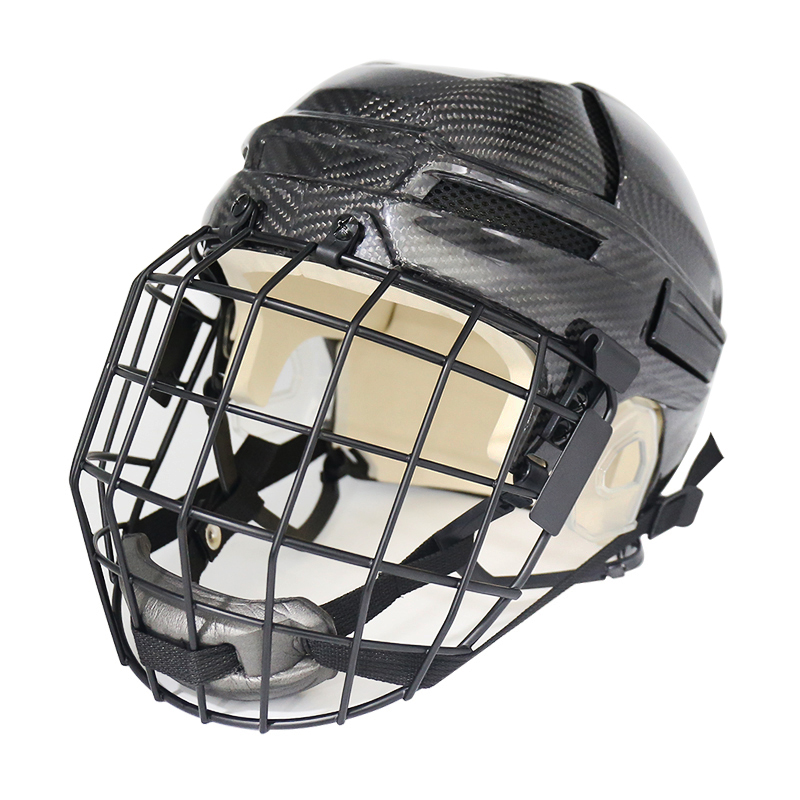
Inner liners dictate both comfort and energy deceleration. Traditional foam configurations dominated the market for decades. Vinyl Nitrile (VN) offers a soft, incredibly comfortable fit. It provides a classic, traditional feel older players strongly prefer. Unfortunately, VN adds noticeable weight to the final product. It also severely limits crucial air circulation inside the shell. Expanded Polypropylene (EPP) and Expanded Polystyrene (EPS) solve the heavy weight problem. They provide excellent high-mass impact absorption capabilities. However, bare EPP feels highly rigid against the skull. It requires secondary soft comfort padding to prevent severe skin irritation.
Next-generation protective solutions utilize advanced elastomers. A 3D printed helmet liner works through complex geometric lattice structures. Engineers tune these digital lattices precisely for optimal energy dampening. They target specific impact zones across different head areas. Carbon3D technology exemplifies this exact engineering approach perfectly. Thicker struts protect the fragile temple regions. Softer struts cradle the crown for maximum comfort.
Evaluation reveals distinct physiological advantages for players. These modern liners offer superior heat dissipation immediately. Thousands of open air channels let trapped heat escape quickly. They also create highly customized fit profiles based on head scans. Trade-offs certainly exist for early technology adopters. You will face a premium retail price point. You might experience added weight depending on the specific lattice density used. Some early materials showed potential susceptibility to extreme cold-weather stiffening. However, top brands test them heavily against freezing rink conditions.
Here is a structural comparison of these interior materials:
| Interior Material | Primary Benefit | Key Drawback | Ideal Player Profile |
|---|---|---|---|
| Vinyl Nitrile (VN) | Soft, conforming comfort | Heavy, poor heat dissipation | Recreational, classic feel |
| Expanded Polypropylene (EPP) | Lightweight, absorbs hard hits | Rigid, requires extra padding | Competitive, frequent impacts |
| 3D Printed Elastomer | Max breathability, custom fit | High price, potential weight | Elite, heavy sweaters |
Mandatory standards dictate legal headgear usage globally. Organizations evaluate materials rigorously against strict testing protocols. The Hockey Equipment Certification Council (HECC) governs safety in the USA. The Canadian Standards Association (CSA) handles Canadian testing requirements. The CE mark dictates European compliance standards. These independent certifications test for minimum safety thresholds constantly.
To pass these certifications, manufacturers submit their designs to independent testing labs. The evaluation process involves several crucial steps:
Testing realities often clash with aggressive marketing narratives. Certifications do not rate actual concussion prevention. Buyers should treat any "concussion-proof" claims heavy skepticism. No external material can fully stop internal brain sloshing. Modern designs focus heavily on rotational impact management instead. Engineers use floating liners and multi-density foam pods strategically. These components reduce dangerous sheer forces actively during twisting falls. They operate independently of the chosen outer shell material.
Bridging material specifications and actual ice performance reveals hidden pitfalls. The fit fallacy represents the biggest danger for consumers. A $400 helmet featuring advanced 3D printing might fail you. It provides inferior protection to a basic $100 model if it fits poorly. Premium headgear leaving negative space around the temples creates dangerous vulnerabilities. Gaps near the occipital bone ruin the engineered energy transfer mechanics. Force travels straight to the skull instead of dispersing through the pads.
Maintenance and material degradation also dictate safety outcomes immensely. Advanced materials do not last forever under harsh conditions. EPP foams harden significantly over time due to sweat exposure. Polycarbonate degrades slowly from continuous UV exposure. Harsh chemical cleaners accelerate plastic breakdown rapidly. Helmets carry strict expiration dates regardless of advanced materials. They typically expire 6.5 years from the HECC sticker date. You must replace them immediately once this date passes.
Adoption friction also slows down new technology rollouts. Players transitioning to ultra-stiff composite shells face unique challenges. Rigid lattice liners often require an initial physical break-in period. Users frequently report early discomfort compared to legacy soft-foam models. Your head needs time to compress the new materials properly. Patience remains critical when upgrading to elite-level protective equipment.
Elite and high-frequency players need specific performance features. You should prioritize heat management and targeted energy displacement heavily. Look actively for 3D printed elastomer inner configurations. Multi-density EPP setups also perform exceptionally well during intense games. The premium cost easily justifies the resulting performance comfort. You will appreciate the enhanced breathability during long, exhausting shifts.
Recreational or beer league players have different practical needs. Traditional dual-density VN foams work perfectly fine for casual play. Basic EPP foams housed in standard polycarbonate shells offer adequate protection. They handle lower-velocity impacts safely at a mere fraction of the cost. You do not need aerospace-grade materials for weekend league games.
Your next steps require careful physical preparation before purchasing:
A: Pure carbon fiber is exceptionally lightweight and stiff, but it proves too brittle for hockey. Repetitive, localized impacts like hard puck strikes can cause micro-fractures in pure carbon shells. Manufacturers also face astronomical production costs. Therefore, brands prefer composite blends or strategic structural inserts to save weight while passing strict multi-impact drop certifications.
A: They are not inherently "safer" regarding standard certifications, as both must pass the exact same strict HECC/CSA safety baselines. However, 3D printed elastomers offer vastly superior breathability and highly customized fit profiles. A better, closer fit ensures the materials interface correctly with your head, which indirectly optimizes your overall protection.
A: Helmet materials degrade steadily due to constant sweat, chemical cleaners, and extreme temperature cycles in the rink. EPP foams harden, and polycarbonate shells lose flexibility. Due to this natural material breakdown, the HECC strictly mandates that helmets expire 6.5 years from the certification sticker date. You must replace them afterward.

