
- Home
- Products
- HOT
- Technology
- Service
- Resources
- About
- Contact
- All
- Product Name
- Product Keyword
- Product Model
- Product Summary
- Product Description
- Multi Field Search

Views: 0 Author: Site Editor Publish Time: 2026-11-17 Origin: Site


The professional and elite-amateur hockey markets demand protective gear pushing the absolute limits of performance. Today, athletes expect ultra-lightweight designs. They refuse to compromise on safety. This expectation drives a massive surge in premium material adoption across the industry.
For product managers and B2B buyers, navigating this shift presents a monumental challenge. You must balance the extraordinarily high production costs of advanced composites against strict safety compliance. Every Ice Hockey Helmet must pass rigorous testing. One wrong material choice can lead to catastrophic testing failures. It can also destroy your profit margins before production even begins.
This article offers an objective, manufacturer-agnostic framework to evaluate these emerging technologies. We will explore how to assess carbon fiber shells and additive manufacturing processes effectively. You will learn how to vet suppliers, navigate certification hurdles, and bring next-generation head protection to market successfully.
A carbon fiber ice hockey helmet significantly reduces shell weight but requires precise resin selection and layup processes to pass multi-impact certification standards.
Evaluating a 3D printed helmet liner requires analyzing lattice structure tunability, rotational impact absorption, and scalable additive manufacturing capacity.
Safety certifications (HECC, CSA, CE) dictate strict pass/fail criteria; viable OEM partners must demonstrate a proven track record in pre-certification testing.
Supply chain feasibility hinges on unit economics: balancing the high tooling costs of composite shells with the slow batch-yields of 3D-printed elastomers.
Brands can no longer rely solely on legacy materials to dominate the market. You must innovate to capture the highly lucrative premium retail and pro-stock segments. This requires a strategic shift in how you design and manufacture protective equipment.
Historically, manufacturers relied heavily on high-density polyethylene (HDPE) shells. They paired these plastics alongside EPP or EVA foam combinations. These materials work well for entry-level and mid-tier products. However, elite players demand more. Moving beyond traditional plastics allows you to position your brand in the premium tier. Developing high-end OEM hockey helmets attracts professional athletes and serious amateurs. These consumers willingly pay premium prices for verifiable performance upgrades.
You must define project viability early in the development cycle. Establish clear target retail price points before engineering begins. Determine your targeted weight reduction in exact grams. A lighter helmet reduces neck fatigue during long shifts. Furthermore, you need distinct aesthetic differentiators. Consumers must see the premium value immediately on the retail shelf. Visible carbon weaves or exposed 3D-printed lattices serve as powerful visual cues. They communicate advanced technology instantly.
Advanced materials introduce complex financial variables. You must calculate the return on investment (ROI) carefully. Custom composite tooling requires significant upfront capital. Additive manufacturing licenses also carry high ongoing fees. Compare these expenses against your projected sales volumes in the elite player tier. High retail prices can offset these costs. However, you must ensure your manufacturing partner can deliver consistent quality to protect your margins.
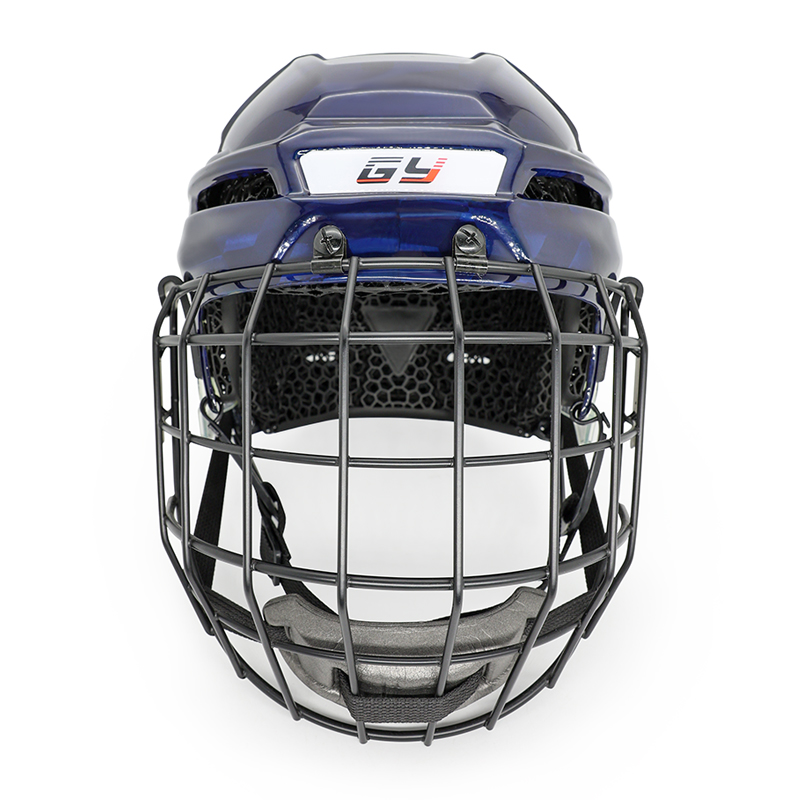
The outer shell serves as the first line of defense against high-velocity pucks and rigid boards. Choosing the right material dictates both the weight and the structural integrity of the final product.
A true carbon fiber ice hockey helmet offers an unmatched weight-to-strength ratio. It drastically outperforms polycarbonate or reinforced nylon alternatives. Carbon composites provide immense rigidity. They disperse localized impact energy across the entire shell surface. This allows engineers to thin out the shell walls safely. The result is a noticeably lighter helmet. Players experience less fatigue and better mobility on the ice.
You cannot simply mold carbon fiber like basic plastics. Assess your OEM capabilities in continuous fiber orientation. They must understand prepreg composites thoroughly. Resin transfer molding (RTM) is often necessary to achieve consistent shell thickness. Poor manufacturing processes lead to dry spots or air voids. These defects cause catastrophic shell delamination under puck impact. Your factory partner must demonstrate mastery over complex layup schedules.
Ice rinks present a unique environmental challenge. Temperatures drop significantly near the ice surface. Many standard plastics become dangerously brittle in these conditions. You must evaluate the brittleness and energy dispersion capabilities of composite shells at typical rink temperatures. The resin system must remain slightly ductile. If the resin cures too rigidly, the carbon shell will shatter upon impact instead of flexing.
Beware of deceptive manufacturing practices. Many suppliers offer "carbon look" hydro-dipping. Others use fiberglass-backed carbon laminates. These methods provide the aesthetic appeal of carbon fiber. However, they fail to provide any structural benefits. They add unnecessary weight and compromise safety. Always demand full structural carbon layups for premium helmet programs.
Material Type | Weight Profile | Impact Resistance (Cold) | Manufacturing Complexity |
|---|---|---|---|
Carbon Fiber Composite | Ultra-Light | Excellent (Resin Dependent) | Very High |
Polycarbonate | Medium | Good | Low (Injection Molded) |
HDPE | Heavy | Moderate | Very Low |
The interior liner manages the energy transfer from the shell to the player's head. Additive manufacturing has revolutionized how engineers approach this critical component.
Traditional dual-density foams compress linearly. They struggle to manage twisting forces effectively. A 3D printed helmet liner changes this dynamic entirely. It utilizes finely tuned lattice structures. Engineers can adjust the strut thickness and node density across different zones. This allows the liner to manage both linear and rotational impact forces simultaneously. The lattice collapses and shears upon impact. It absorbs energy far better than standard EPP or EVA foams.
The printing process relies on advanced polymers. You must evaluate the elastomers and photopolymer resins used. Digital Light Synthesis (DLS) is a popular method for creating these structures. The chosen material must offer extreme durability. It needs excellent moisture resistance to withstand sweat and melted ice. Furthermore, it requires perfect shape memory. The lattice must return to its original form instantly over a multi-season lifespan.
Additive manufacturing allows for unprecedented personalization. Assess the OEM's software stack carefully. Review their scanning-to-print workflow. Can they scale operations efficiently? Creating a one-off pro-stock customization is relatively easy. Scaling that process to standardized retail sizing is incredibly difficult. Your partner needs robust software automation to generate distinct lattice sizes for mass production.
Heat retention is a major complaint among hockey players. Closed-cell foam inserts trap body heat against the scalp. Analyze the airflow advantages of open-lattice 3D printed structures. The porous nature of the lattice allows heat to escape naturally. Cool air flows freely through the helmet during play. This thermal regulation improves player comfort and performance significantly.
Bringing a helmet to market requires passing stringent safety tests. You cannot bypass or rush this phase. Compliance is a legal and ethical mandate.
Different regions enforce different safety standards. You must meet mandatory requirements for HECC in the USA. Canada requires CSA approval. Europe mandates CE certification. Each governing body utilizes specific drop-test heights and headform weights. They measure the peak gravitational force (G-force) transferred to the headform. Failing even one metric prevents your product from entering that specific market.
Do not rely solely on third-party certification labs for initial testing. Evaluate whether your OEM partner possesses in-house testing equipment. They need calibrated drop-test rigs. They should also operate linear impact simulators. In-house testing expedites the R&D phase dramatically. It allows engineers to tweak carbon layups and lattice densities rapidly before submitting final samples for official certification.
Hockey is a highly physical sport. Helmets sustain repeated low-to-medium velocity impacts during a single game. This presents a specific difficulty for composite shells and 3D liners. They must sustain and recover from these repeated impacts without degrading. Some rigid foams crush once and lose their protective qualities. Your 3D printed elastomers must demonstrate rapid recovery times between shifts.
Marketing protective gear requires strict ethical boundaries. Clarify internally and externally that no helmet prevents concussions. Concussions occur due to brain acceleration inside the skull. Compliance marketing must strictly align with verifiable impact energy reduction data. Avoid making medical claims. Focus your messaging on advanced energy dispersion and superior material engineering.
Transitioning from concept to mass production involves significant logistical hurdles. You must anticipate these bottlenecks to keep your launch on schedule.
Advanced materials require patience. Factor in the 6-to-12 month development cycles typical for this tier of equipment. Custom carbon tooling takes weeks to machine and polish. 3D printing iterations require extensive digital modeling and test prints. You cannot rush the curing times of composite resins. Plan your go-to-market strategy around these extended prototyping constraints.
Understand the non-linear cost curves of additive manufacturing. Injection molding becomes cheaper as volume increases. 3D printing does not benefit from this traditional economy of scale. Printing 10,000 liners takes proportionally as long as printing 100 liners. You must secure enough printer fleet capacity to meet your launch demands. Calculate your unit costs based on machine time and resin consumption.
Identify common failure points early in the production run. Watch out for inconsistent shell bonding. The adhesive securing the liner to the carbon shell must withstand extreme temperature fluctuations. Monitor for lattice print failures, such as broken struts or uncured resin pockets. Poor integration between the rigid carbon shell and the flexible 3D printed liner will ruin the helmet's performance.
Visual inspection of carbon weave for dry spots.
Resin cure verification using thermal analysis.
Lattice compression testing on random batch samples.
Adhesive peel-strength testing between shell and liner.
Your manufacturing partner dictates the success or failure of your premium helmet program. Vet them rigorously before signing any development contracts.
Do not accept marketing brochures at face value. Request anonymized testing data from prospective factories. Ask to see their material safety data sheets (MSDS) for all resins and elastomers. Review their historical pass rates for HECC and CSA certifications. A reliable partner will share this data willingly to prove their engineering competence.
Verify the physical infrastructure of the supplier. They should ideally have composite curing autoclaves and industrial-grade 3D printer fleets under one roof. If they do not, they must demonstrate a seamlessly integrated sub-contractor network. Transporting raw carbon shells to a separate facility for liner integration introduces QC risks and delays.
Initiate a formal Request for Information (RFI). Focus your questions on past compliance successes. Ask for their minimum order quantities (MOQs) for both composite shells and printed liners. Finally, scrutinize their intellectual property (IP) protection protocols. You must ensure your proprietary lattice designs and shell geometries remain secure from competitors.
Building a next-generation hockey helmet requires a delicate balance. You must merge bleeding-edge materials like carbon fiber and 3D printing with rigid safety compliance. Success depends entirely on meticulous engineering and strict quality control.
Start your journey with a limited-run prototype phase. Use this smaller batch to validate both impact performance and unit economics. Do not commit to mass production until you achieve consistent, repeatable results in the drop-test lab. By carefully vetting your OEM partners and understanding the material science, you can successfully disrupt the premium hockey protection market.
A: A carbon fiber shell can reduce overall helmet weight by 15% to 25% compared to traditional HDPE plastics. This often translates to a reduction of 50 to 100 grams. However, total weight heavily depends on the integrated hardware, the density of the internal liner, and the specific cage or visor setup attached to the shell.
A: Retrofitting is highly discouraged and engineering-intensive. Impact energy transfer requires cohesive shell-to-liner integration. A 3D printed lattice must be digitally mapped to the exact internal geometry of the specific shell. Forcing a generic printed liner into an older plastic shell compromises the energy dispersion mechanics and will likely fail safety certifications.
A: Composite manufacturing runs usually require MOQs between 500 and 1,000 units per size due to the high cost of aluminum or steel tooling. In contrast, 3D printed components offer lower-volume flexibility. You can often print liners in batches as small as 50 units, though the rigid shell production will still dictate your overall order volume.
A: No. Modern UV-cured elastomers used in premium 3D printing are highly chemically resilient. They resist degradation from sweat, bacteria, and ice rink moisture far better than traditional open-cell foams. Additionally, the open-lattice structures are incredibly easy to wash and dry, preventing the odor buildup common in legacy hockey helmets.


