

- Home
- Products
- HOT
- Technology
- Service
- Resources
- About
- Contact
- All
- Product Name
- Product Keyword
- Product Model
- Product Summary
- Product Description
- Multi Field Search

Views: 0 Author: Site Editor Publish Time: 2026-09-01 Origin: Site


Ice hockey head protection has transitioned from rudimentary leather caps and basic fiberglass shells to highly engineered, multi-material impact management systems designed to mitigate complex linear and rotational forces. The shift from basic skull-guard shells to advanced material science reflects a continuous effort to solve real-world on-ice trauma problems. Buyers often evaluate helmets based on brand popularity or aesthetics rather than the underlying manufacturing processes, shell customization, and material sciences that dictate actual safety and fit.
Understanding exactly how an ice hockey helmet is manufactured—from traditional high-density polyethylene (HDPE) injection molding to advanced custom 3D printed linings—is the most reliable framework for evaluating performance, durability, and overall value. We will break down the engineering behind these protective units, helping you make informed decisions based on structural integrity, fit protocols, and modern manufacturing techniques.
Material Dictates Performance: The shift from dual-density foams to custom 3D printed elastomeric lattices fundamentally changes how an ice hockey helmet disperses impact energy.
Manufacturing Methods Define Fit: Traditional injection-molded HDPE shells offer scalable, cost-effective protection, while additive manufacturing enables 1-to-1 custom fits.
Color and Aesthetic Customization: HDPE injection molding provides teams with scalable color personalization options, which remains a key logistical advantage for team procurement.
Certifications are the Baseline, Not the Ceiling: HECC, CSA, and CE certifications are mandatory legal minimums; buyers must look at independent testing (e.g., Virginia Tech ratings) and structural engineering to differentiate elite models.
Lifecycle Realities: The manufacturing materials degrade over time; understanding foam compression and plastic embrittlement is critical for replacement cycles.
The outer shell serves as the first line of defense. It must offer puncture resistance against skate blades and sticks, flex under impact to absorb initial energy, and maintain structural integrity in freezing arena temperatures. Traditional HDPE plastic provides a reliable balance of these traits. Manufacturers favor HDPE because it handles cold environments without shattering. Emerging carbon composite shells push the boundaries further. They offer superior weight-to-strength ratios that reduce neck fatigue without sacrificing impact resistance. HDPE shells also excel in personalization. They allow for easy color-matching to team uniforms and provide strong adhesion for exterior decals.
Material Type | Impact Flex | Cold Weather Durability | Weight Profile | Customization Potential |
|---|---|---|---|---|
HDPE Plastic | High (Absorbs initial shock) | Excellent (Resists shattering) | Moderate | High (Color matching, decals) |
Carbon Composite | Low (Rigid deflection) | Excellent | Ultra-Lightweight | Moderate (Often painted) |
Internal liners manage the energy that passes through the shell. Expanded Polypropylene (EPP) is rigid and designed for high-energy, catastrophic impacts. You will often see EPP paired with softer comfort foams. Vinyl Nitrile (VN) foam is softer, providing comfort and managing low-energy impacts. The industry is currently shifting toward geometric lattice structures. These complex designs manage multi-directional forces more effectively than traditional foams. They collapse at specific rates depending on the angle and severity of the impact.
Facial protection requires precision engineering. Polycarbonate visors offer high optical clarity. Manufacturers treat them with anti-scratch and anti-fog coatings to maintain visibility during intense play. Alternatively, wire cages constructed from titanium or stainless steel provide maximum airflow. They offer structural protection against pucks and sticks, though they add weight compared to half-shields. Players must choose based on visibility preferences and league regulations.
The traditional manufacturing process relies on heavy industrial machinery. It begins with heating HDPE pellets until molten. This liquid plastic is injected into two-piece steel molds under extreme high pressure. The mold design dictates the placement of ventilation ports, structural ridges for added rigidity, and integrated mounting points for ear guards and facial protection hardware.
Raw HDPE pellets are loaded into a heated hopper.
The material melts into a highly viscous liquid state.
High-pressure rams force the liquid into precision-milled steel molds.
The mold holds the pressure to ensure no air bubbles form in the shell walls.
Thermal regulation during the cooling phase prevents the plastic from warping. Uneven cooling develops internal stresses that create weak points. Once cured, the mechanical assembly involves attaching the front and back shell pieces. This is typically achieved using tool-less adjustment tracks or traditional screw-and-post systems. These mechanisms allow the helmet to expand or contract for a better fit.
Injection molding offers significant advantages in mass production. It lowers retail costs and provides predictable baseline safety. It also allows for easily customized team colorways. However, the reliance on generic head shapes often leads to pressure points or negative space. This compromises both comfort and optimal impact dispersion for players whose head shapes fall outside the statistical norm.
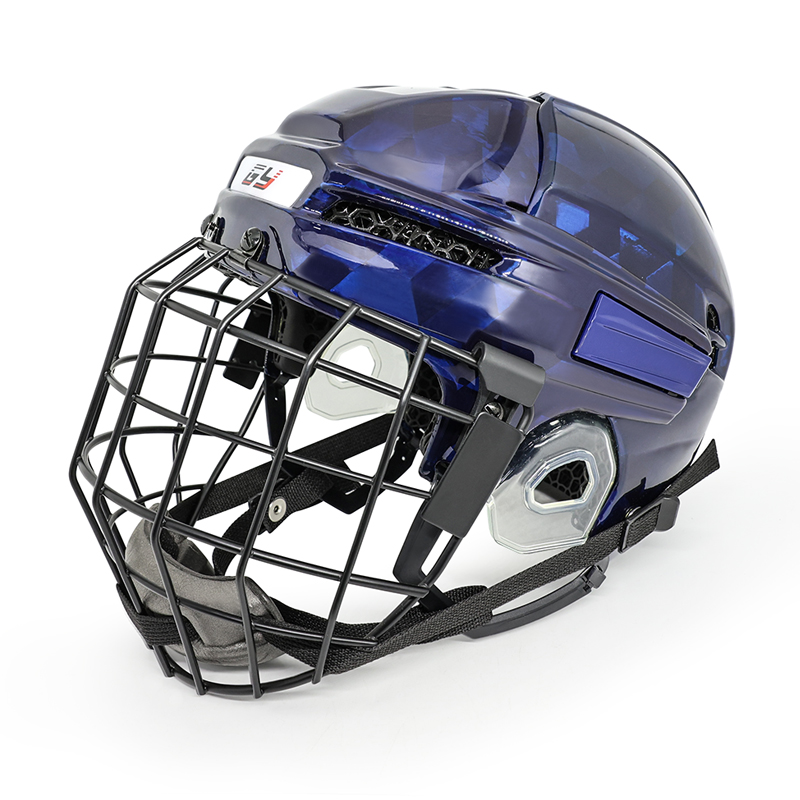
Industrial partnerships utilizing Digital Light Synthesis (DLS) have enabled the scalable manufacturing of standardized 3D printed lattice liners. Precision engineering ensures consistency across mass-produced elastomeric lattices. This represents a significant upgrade over traditional manual foam-laying processes. Manual processes often suffer from human error, adhesive failures, and material inconsistencies.
The front-end process for custom-built helmets utilizes LiDAR or photogrammetry. Technicians map the exact topography of a player's skull. Software translates this scan data into a digital twin. Engineers use this digital model to map localized impact zones and tailor the liner's density to the specific contours of the individual's head.
Using these digital models, manufacturers produce a Carbon Fiber 3D Printed Ice Hockey Helmet lining. These variable-density elastomeric lattices feature struts that are precisely tuned to absorb specific impact velocities. This level of granular tuning is impossible to achieve with traditional block foams. The printer builds the lattice layer by layer, curing the liquid resin with UV light.
Custom-printed linings eliminate negative space between the head and the shell. By ensuring total contact, the liner drastically reduces rotational acceleration during collisions. It locks the head in place and disperses energy uniformly across the lattice structure. This uniform dispersion is a massive leap forward in concussion mitigation technology.
Accurate sizing begins with measuring the head circumference. Take the measurement exactly one inch above the eyebrows using a flexible tape measure. Match this measurement to the specific manufacturer's sizing chart. Shell shapes and volume vary significantly between brands. A medium in one brand might fit like a large in another.
Evaluate the helmet's adjustment mechanisms. Tool-free side clips, micro-dial adjustment systems, and multi-directional sliding shells allow the helmet to expand or contract. Proper adjustment ensures the shell sits securely without requiring excessive force to close the locking mechanisms. If you have to force the clips shut, the helmet is too small.
Open all adjustment clips or dials fully.
Place the helmet on the head, ensuring the front edge sits one finger-width above the eyebrows.
Close the shell until it sits snugly against the temples and occipital bone.
Lock the adjustment mechanisms in place.
Test the helmet for key contact points. Check the occipital lock at the base of the skull to ensure the helmet cannot tilt forward. Ensure temple comfort without pinching. Verify the margin of safety above the brow line. Shake your head side to side; the helmet should move with your skin, not slide over it.
Evaluate the trade-off between a lightweight feel and the mass required to absorb heavy impacts. Lighter helmets reduce neck fatigue during long shifts. However, structural integrity must remain robust enough to handle high-velocity pucks and heavy body checks. Manufacturers constantly tweak shell thickness to find the perfect balance.
Examine how different manufacturing designs address rotational forces. These forces are the primary cause of concussions. Advanced helmets utilize slip-planes, floating liners, or independent suspension systems. These designs allow the shell to move slightly independently of the liner. This movement redirects rotational energy away from the brain during glancing blows.
Assess how shell ventilation aligns with interior liner channels to dissipate heat. Closed-cell foams resist moisture but can trap heat. Open 3D lattices provide superior airflow and handle sweat absorption effectively. Better airflow reduces bacterial growth and odor, extending the usable life of the internal components.
Liner Material | Impact Absorption Type | Moisture Management | Airflow/Ventilation |
|---|---|---|---|
EPP Foam | High-Energy Linear | Closed-cell (Resists sweat) | Low |
VN Foam | Low-Energy / Comfort | Open-cell (Absorbs sweat) | Moderate |
3D Printed Lattice | Multi-directional / Rotational | Washable / Non-absorbent | High |
Mandatory testing protocols are required for legal play. These include drop tests, penetration tests, and retention system tests. Helmets must carry valid HECC (USA), CSA (Canada), or CE (Europe) certification stickers to be used in sanctioned leagues. Referees check these stickers before games.
Interpret the Virginia Tech STAR rating system as a supplementary evaluation tool. Certifications establish a legal baseline. Independent ratings provide comparative data on how well different helmets manage real-world hockey impact scenarios. A five-star rating indicates superior performance in laboratory impact tests.
Purchasing secondary-market helmets carries severe risks. Chemical degradation of HDPE and foams compromises safety over time. This material fatigue is why HECC certifications expire exactly 6.5 years from the date of manufacture. Never use an expired or visibly damaged helmet. The plastics become brittle and the foams lose their rebound properties.
A cost-benefit analysis is essential. The return on investment of a premium carbon fiber 3D printed model makes sense for elite players requiring exact fit and maximum impact dispersion. Conversely, a traditional HDPE model provides adequate, certified protection for recreational players. You must weigh your level of play against the protective features offered.
Equipment managers must balance budget constraints with roster safety. Decision frameworks should include bulk ordering logistics and team color customization capabilities of HDPE shells. Inventory management strategies for adjustable helmets are also necessary. Adjustable models can fit multiple head shapes across a roster, reducing the need to stock excessive inventory of specific sizes.
The manufacturing process of an ice hockey helmet is the primary indicator of its protective capabilities, customization potential, and lifecycle value. Buyers should segment their options based on head shape compatibility, required certification levels, aesthetic personalization requirements, and the specific impact profile of the player's position and league.
Schedule a professional 3D head scan to determine if a custom-fit lattice liner matches your head profile.
Test the pressure points of various HDPE shell shapes with a certified fitter before finalizing a purchase.
Verify the expiration date on the HECC sticker to ensure compliance for league play.
Inspect the shell and liner weekly for micro-cracks, foam degradation, or loose J-clips.
A: Helmets should be replaced every 5 to 6.5 years, or immediately following a severe impact or visible damage. HECC certifications expire 6.5 years after the manufacturing date due to the natural chemical degradation of the plastics and foams.
A: It is a helmet that utilizes additive manufacturing to create a custom-fit, variable-density elastomeric lattice liner based on a digital scan of the player's head, often paired with a lightweight carbon composite shell for superior impact dispersion.
A: High-Density Polyethylene (HDPE) is used because it offers an excellent balance of impact resistance, cold-weather durability, flexibility, and cost-effective mass production through injection molding.
A: They eliminate negative space between the head and the shell, providing a perfect fit that reduces rotational acceleration and utilizes precisely tuned lattice struts to absorb specific impact velocities better than traditional foam.
A: Expanded Polypropylene (EPP) is a hard foam designed to absorb high-energy, catastrophic impacts. Vinyl Nitrile (VN) is a softer foam that provides comfort and manages low-energy, everyday impacts.
A: Generally, no. The internal liners are permanently bonded or structurally integrated into the shell. Replacing them compromises the helmet's certification and structural integrity. If the liner is damaged, the entire helmet must be replaced.


