

- Home
- Products
- HOT
- Technology
- Service
- Resources
- About
- Contact
- All
- Product Name
- Product Keyword
- Product Model
- Product Summary
- Product Description
- Multi Field Search

Views: 0 Author: Site Editor Publish Time: 2026-09-10 Origin: Site


The protective efficacy of any headgear on the ice is directly proportional to how well it interfaces with the player's unique cranial geometry. Even the highest-rated, most technologically advanced ice hockey helmet offers severely compromised protection if improperly sized. When a shell shifts during an impact, internal foams cannot properly disperse linear or rotational forces, leaving the brain vulnerable. Players and parents frequently misdiagnose fit, prioritizing brand aesthetics or tolerating pressure-point headaches. This increases the risk of rotational and linear impact injuries. A helmet should never cause pain or require extreme tightening of the chin strap to stay in place. This guide outlines an objective framework for evaluating helmet fit. We compare traditional adjustment mechanisms against emerging technologies like the Custom Fit 3D Printed Ice Hockey Helmet, establishing criteria for a confident purchasing decision.
A properly fitted ice hockey helmet must sit flush against the head without shifting during dynamic movement, while remaining free of localized pressure points.
Head shape (oval vs. round) is as critical as head circumference; evaluating brand-specific shell profiles is a mandatory step in the selection process.
Advanced solutions, such as the custom fit 3D printed ice hockey helmet, eliminate the traditional trade-off between comfort and maximum impact dispersion.
Safety certifications (HECC, CSA, CE) are non-negotiable and have strict expiration dates that dictate replacement timelines regardless of current fit.
Defining the exact physical parameters of a correct fit is the first step in maximizing on-ice safety. The helmet must sit square on the head, positioned exactly one finger-width—approximately 0.5 to 1 inch—above the eyebrows. If the front rim drops lower, it obstructs vision. If it tilts higher, it leaves the frontal lobe dangerously exposed during a collision. You want the shell to lock in place naturally before you even snap the chin strap.
There is a distinct difference between necessary retention pressure and circulation-restricting tightness. The internal liner must make continuous, 360-degree contact with the head. You should feel uniform pressure wrapping around the skull without any localized pinching, particularly at the temples or the occipital bone at the base of the skull. If the helmet causes a headache after a few minutes of wear, the shell shape is incompatible with the player's head. Do not assume it will simply "break in" over time.
The chin strap serves as the final retention mechanism, not the primary fit anchor. It must be adjusted so that it sits flush against the chin with no more than a one-finger gap between the strap and the throat. This precise adjustment ensures the helmet cannot be ejected during dynamic play or secondary impacts, while still allowing the player to breathe, speak, and swallow comfortably. A loose strap renders the best helmet useless during a high-speed collision.
To verify stability, perform the lateral and vertical shake test. With the helmet secured, shake your head vigorously from side to side, and then up and down. The skin on the forehead and temples should move in tandem with the helmet. The shell should not slide, wobble, or rotate independently of the head. Any independent movement indicates excess negative space, which drastically reduces the liner's ability to absorb kinetic energy.
Temporal pinching that causes immediate discomfort or throbbing.
Occipital gaps where the back of the helmet fails to cup the base of the skull.
Red marks on the forehead or temples lasting longer than 15 minutes post-removal.
A shell that easily rocks backward to expose the forehead when pushed lightly from the front.
Excessive pressure on the jawline when integrating a facial cage.
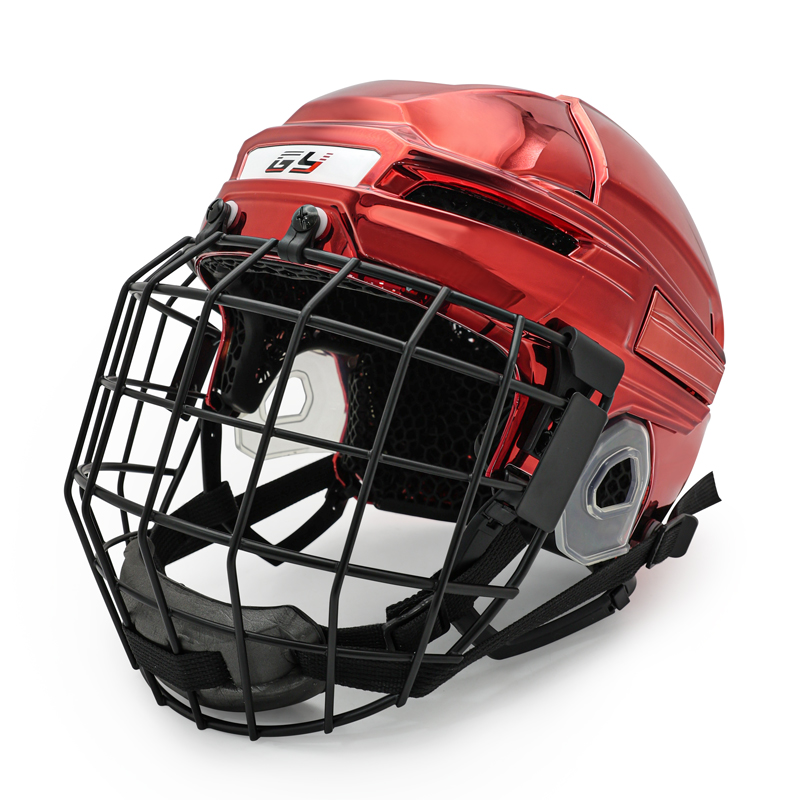
Finding the right ice hockey helmet begins long before trying anything on. Accurate cranial measurement establishes a baseline, narrowing down the vast array of options to a specific size bracket. Guessing your size based on baseball cap measurements often leads to poor equipment choices.
Follow these exact steps to get a proper baseline measurement:
Take a soft cloth tape measure.
Wrap the tape measure roughly one inch above the ears and eyebrows.
Keep the tape level across the occipital bone at the back of the head.
Pull the tape snug, but not tight enough to compress the skin.
Record this measurement in both inches and centimeters, as different manufacturers utilize varying sizing charts.
Head circumference only tells half the story; head shape is equally vital. Manufacturers design their shells around specific cranial profiles. Some brands historically utilize narrower, oval-oriented profiles, while others cater to rounder, wider head shapes. If you have a wide head and force it into a narrow shell, you will experience severe temporal pressure, regardless of whether the circumference measurement aligns with the sizing chart. Always test multiple brands to find the shell that matches your natural head shape.
A dangerous practice among parents is buying a larger youth helmet for a child to "grow into." Excess space inside the shell drastically increases concussion risk. During an impact, a loose helmet stops moving upon contact with the boards or ice, but the child's head continues to accelerate inside the shell, striking the internal foams with unmitigated force. Helmets must fit perfectly on the day they are purchased. There is no compromise when it comes to youth head protection.
Hair thickness, length, and style significantly alter helmet sizing. Braids, dreadlocks, or exceptionally thick hair add volume that must be accounted for. Always measure head circumference and try on helmets with the exact hairstyle that will be worn during play. If a player gets a drastic haircut mid-season, the helmet's fit must be re-evaluated and adjusted accordingly. A sudden reduction in hair volume can turn a perfectly fitted helmet into a loose, dangerous liability.
The fit of the helmet dictates the compatibility and safety of attached cages and visors. The chin cup of a cage must fit snugly against the player's chin without pulling the front of the helmet downward. If the cage is too small, it will distort the overall fit, compressing the shell inward and creating artificial pressure points. Always fit the helmet and the cage together as a complete system.
The market offers various retention and adjustment systems, ranging from basic mechanical locks to highly advanced digital mapping solutions. Understanding these categories helps players choose the right level of customization for their specific needs on the ice.
Standard two-piece shell designs typically utilize longitudinal flip-locks or dial-adjustment retention systems. These mechanisms offer the advantage of ease of use and on-the-fly micro-adjustments on the bench. However, they primarily adjust for length, offering very limited width adjustment. They also introduce moving parts that carry a potential for mechanical failure over time. Dirt, sweat, and ice buildup can jam these mechanisms, making mid-game adjustments difficult.
For players seeking the ultimate in protection and comfort, the Custom Fit 3D Printed Ice Hockey Helmet represents the highest-tier solution. This process involves digital head scanning to map the exact cranial geometry of the player. The resulting data is used to manufacture a 3D printed lattice structure that perfectly contours to every curve and indentation of the skull. This technology bridges the gap between generic sizing and personalized biomechanical protection.
These 3D printed continuous-fit liners eliminate all negative space between the head and the shell. By replacing dense, traditional foams with an open-cell lattice, these helmets drastically improve breathability and sweat management. More importantly, the intricate lattice geometry is highly effective at managing rotational impact energy, shearing and compressing precisely where needed during a collision. The result is a cooler head and superior energy dispersion.
Standard injection-molded helmets cannot accommodate unique head shapes without causing severe pressure points. Players with prominent occipital bones, asymmetrical skulls, or wide temporal lines often struggle to find a comfortable fit off the shelf. A custom fit 3D printed liner solves this by wrapping seamlessly around cranial irregularities, ensuring maximum contact area for optimal force dispersion. You no longer have to choose between safety and comfort.
The internal padding is the engine of a helmet's protective capability. Different materials react differently to various types of impact energy, and modern helmets often utilize a hybrid approach to maximize safety.
Liner Material | Impact Profile | Fit Characteristics | Best Application |
|---|---|---|---|
VN (Vinyl Nitrile) Foam | Multiple low-energy impacts | Soft, conforming, contouring | Recreational play, traditional feel |
EPP (Expanded Polypropylene) | High-energy, catastrophic impacts | Stiff, lightweight, requires comfort pads | Competitive leagues, high-speed impacts |
3D Printed Lattice | Omnidirectional, rotational mitigation | Zero negative space, custom mapped | Elite protection, irregular head shapes |
Traditional VN foam is softer and highly effective at managing multiple low-energy impacts. It offers a conforming, contouring fit that many players find immediately comfortable. Conversely, EPP foam is stiffer and lighter, engineered specifically for high-energy, catastrophic impacts. Because EPP does not compress easily under light pressure, it is almost always paired with softer comfort pads to ensure a wearable fit. Knowing which foam your helmet uses helps you understand its protective limits.
Modern engineering incorporates multi-density layering and non-Newtonian materials to handle dynamic impacts. Materials that remain soft and pliable during normal wear but instantly harden upon impact provide excellent energy absorption. Suspended liner systems are also utilized to manage rotational acceleration, allowing the shell to move slightly independently of the liner to deflect glancing blows. This layered approach addresses both direct hits and awkward, twisting falls.
Managing rotational forces is critical for concussion prevention. Dedicated slip-plane systems, such as MIPS (Multi-directional Impact Protection System), use a low-friction layer to allow the head to slide slightly inside the helmet during an angled impact. Alternatively, the omnidirectional deflection properties of custom-fit 3D printed lattice structures achieve similar rotational mitigation by shearing laterally under stress. Both technologies represent a massive leap forward in player safety.
Liner degradation over time impacts both the tightness and the safety of the equipment. Compression from repeated impacts, the hardening of foam due to age, and erosion from acidic sweat all compromise the internal structure. This degradation necessitates routine fit re-evaluations, as a helmet that fit perfectly on day one may become dangerously loose after two seasons of heavy use. Inspect your liner regularly for cracks, hardening, or missing comfort pads.
Acquiring the right helmet involves navigating several common pitfalls. Understanding these risks ensures that safety is never compromised during the purchasing or fitting process.
Purchasing headgear blindly online carries high return rates and significant safety risks due to brand-specific shape variations. You cannot gauge temporal pressure from a website photo. Rigorously utilize brand-specific sizing charts. Better yet, utilize in-store digital scanning kiosks to determine your exact head shape and size before making an online purchase. Always test the fit in person when possible.
Cutting, shaving, or removing internal foam liners to alleviate pressure points is a highly dangerous practice. This immediately voids all safety certifications and destroys the helmet's ability to disperse impact energy. If modification feels necessary, the helmet is fundamentally the wrong shape or size. Pivot to a different brand profile or invest in a Custom Fit 3D Printed Ice Hockey Helmet. Never take a knife to your protective gear.
A facial cage that is too small for the player's jawline will compress the helmet shell inward when the chin strap is secured. This distorts the intended fit, causing severe temporal pain and compromising the structural integrity of the shell. Ensure the chin cup rests naturally on the chin without forcing the helmet down over the eyebrows.
Using a thick, un-molded mouthguard alters jaw alignment. This can put upward pressure on the chin strap, shifting how the helmet sits on the brow and exposing the forehead. Always fit the helmet while wearing the specific mouthguard that will be used during games. The entire head protection system must work together seamlessly.
Selecting the right headgear requires strict adherence to biomechanical fit criteria rather than brand loyalty or aesthetic preferences. A poorly fitted shell compromises even the most advanced protective technologies.
Measure your head circumference accurately using a soft cloth tape measure.
Test at least three different brand profiles to identify the shell shape that matches your cranial geometry.
Check the HECC or CSA expiration date on your current helmet and replace it immediately if expired.
Consult a certified fitter or utilize a digital scanning tool to explore custom 3D printed options if you experience pressure points.
A: Signs include tension headaches, red marks on the temples lasting after removal, the helmet sitting too high on the forehead, or the inability to close the side or rear adjustment tabs fully.
A: No. While comfort pads may require a brief breaking-in period, a headache indicates a fundamentally incompatible shell shape causing dangerous cranial pressure points. It should be snug, never painful.
A: Under HECC rules, a helmet expires 6.5 years from its manufacturing date. Internal foams physically degrade over time due to sweat acidity, temperature fluctuations, and repeated impacts.
A: Yes, especially for players with irregular head shapes, histories of fit-related discomfort, or those seeking maximum ventilation and elite-level rotational impact protection without negative space.
A: Thick winter hats compromise the safety certification and alter the intended fit. Only wear thin, moisture-wicking, approved skull caps designed specifically to fit under sports helmets.
A: Most traditional helmets only adjust for length. If a helmet is too tight on the sides, you must switch to a different helmet model with a wider profile or move to a custom 3D printed option.
A: This is highly unsafe. An oversized helmet will slide during an impact, leaving the forehead or occipital region completely unprotected and drastically increasing the risk of concussion.


