

- Home
- Products
- HOT
- Technology
- Service
- Resources
- About
- Contact
- All
- Product Name
- Product Keyword
- Product Model
- Product Summary
- Product Description
- Multi Field Search

Views: 0 Author: Site Editor Publish Time: 2026-08-03 Origin: Site


The fundamental architecture of head protection in hockey is undergoing its most significant shift in decades. We are moving away from traditional static foams to engineered digital materials validated at the highest professional levels, including the NHL. Traditional dual-density foams force a compromise between impact absorption, weight, and thermal regulation. Standard retail molds often leave micro-gaps between the skull and the liner, reducing optimal energy dispersion during impacts. The introduction of the 3D Printed Liner Ice Hockey Helmet addresses these compromises by utilizing tunable lattice structures. This guide evaluates the engineering, protective capabilities, and practical realities of upgrading to 3D printed helmet technologies. We will look at how these materials perform on the ice, how they manage heat during intense shifts, and what players need to know before making an equipment change.
Dynamic Impact Absorption: 3D printed lattice structures allow for variable density within a single continuous liner, optimizing energy dispersion for both low-velocity bumps and high-velocity impacts.
NHL-Validated Technology: Originally debuted and certified for NHL use, industrial-grade 3D printed liners represent a proven leap forward in professional-grade protective equipment.
Superior Thermal Regulation: Unlike closed-cell foams that trap heat, the open-strut geometry of 3D printed liners actively facilitates airflow, reducing core temperature and fatigue.
Customization vs. Retail: While true custom 3D printed liners require professional head-scanning, retail versions still offer superior micro-adjustability and conformity compared to traditional foam blocks.
The Cost Trade-Off: 3D printed helmets represent the highest price tier in the market; buyers must weigh the premium cost against the specific protective and performance demands of their level of play.
An elite helmet must manage rotational and linear forces while remaining lightweight and comfortable. Traditional manufacturing limits how many different foam densities can be glued together without adding bulk. For years, equipment managers and manufacturers relied on Vinyl Nitrile (VN) and Expanded Polypropylene (EPP) foams. VN provides a soft, comfortable fit but bottoms out quickly under severe impacts. EPP handles high-velocity trauma effectively but feels rigid against the skull. Combining them requires adhesives and segmented blocks. These blocks add weight and disrupt continuous energy transfer across the helmet shell.
Industrial-grade 3D printing introduces digital foam made from elastomeric polyurethane. Unlike consumer-grade filament printing, which melts plastics layer by layer, industrial production utilizes technologies like Digital Light Synthesis (DLS). This process uses liquid resins and molecular oxygen to produce isotropic parts. The resulting material behaves consistently in all directions. This is a strict requirement for absorbing unpredictable on-ice impacts where players hit the boards, the ice, or each other at high speeds.
The true advantage lies in the physics of lattice structures. Engineers alter strut thickness, cell geometry, and material damping properties within a single, continuous print run. When an impact occurs, individual struts buckle, shear, and damp energy dynamically. Thicker struts sit positioned over the temples or occipital ridge to manage severe blows. Thinner, more flexible struts sit against the crown for comfort. This variable density is achieved without adding separate pieces of material. It keeps the overall structure cohesive and highly responsive to different impact types.
To understand the shift, consider the manufacturing limitations of standard foam. Foam blocks are cut and molded into static shapes. They cannot change density smoothly from one millimeter to the next. A 3D printed lattice changes density seamlessly. The printer simply cures thicker struts in areas requiring high impact resistance and thinner struts where comfort and flex are needed. This continuous gradient eliminates the hard transition zones found in dual-density foam helmets, which often create pressure points on the player's head.
Furthermore, the elastomeric polyurethane used in these liners possesses high rebound resilience. Traditional VN foam compresses and takes time to return to its original shape. If a player takes multiple hits in a single shift, the foam may not fully recover between impacts. The 3D printed lattice snaps back instantly. It maintains its full protective capability regardless of how many times it compresses during a game.
Assessing whether the shift to 3D printing provides a measurable improvement in player safety requires looking at how the material handles complex forces. Hockey impacts rarely happen in a straight line. Glancing blows against the boards or collisions with other players generate shear forces. These forces cause the head to rotate rapidly. Managing this rotation is the primary focus of modern head protection engineering.
Lattice structures excel at multi-directional impact management. Flat foam compresses linearly. A 3D printed matrix shears laterally. This lateral movement helps dissipate the energy that causes rotational acceleration. The lattice acts as a suspension system. It allows the outer shell of the ice hockey helmet to move slightly independently of the liner gripping the player's head. This decoupling effect reduces the sudden twisting motion transferred to the skull.
This variable density operates without added weight. The outer layers of the lattice feel soft against the head, providing immediate comfort. As an impact forces the lattice to compress, the deeper, denser layers stiffen exponentially. This progressive resistance prevents the liner from bottoming out during high-velocity trauma. The energy spreads outward through the interconnected struts rather than driving straight through to the skull.
These liners are fully certified by the HECC, CSA, and CE. They pass rigorous testing protocols for professional and amateur play. They consistently exceed baseline testing metrics for linear and rotational impact absorption. However, no helmet prevents concussions entirely. Protection technologies mitigate impact severity. They cannot stop the brain from moving inside the skull upon sudden deceleration. Players must still practice proper checking techniques and situational awareness on the ice.
Let's break down the specific impact scenarios where lattice structures outperform traditional foams:
Low-Velocity Impacts: Stick checks to the helmet or minor bumps against the glass. The thin outer struts compress easily, absorbing the nuisance energy without transferring a jolt to the player.
High-Velocity Linear Impacts: A direct collision with the boards. The lattice compresses deeply. The thicker base struts engage, providing massive resistance and spreading the force across a wide surface area of the helmet shell.
Rotational Impacts: A glancing shoulder hit to the jaw or side of the head. The lattice shears sideways. The struts bend laterally before compressing, absorbing the rotational energy and slowing the twisting motion of the head.
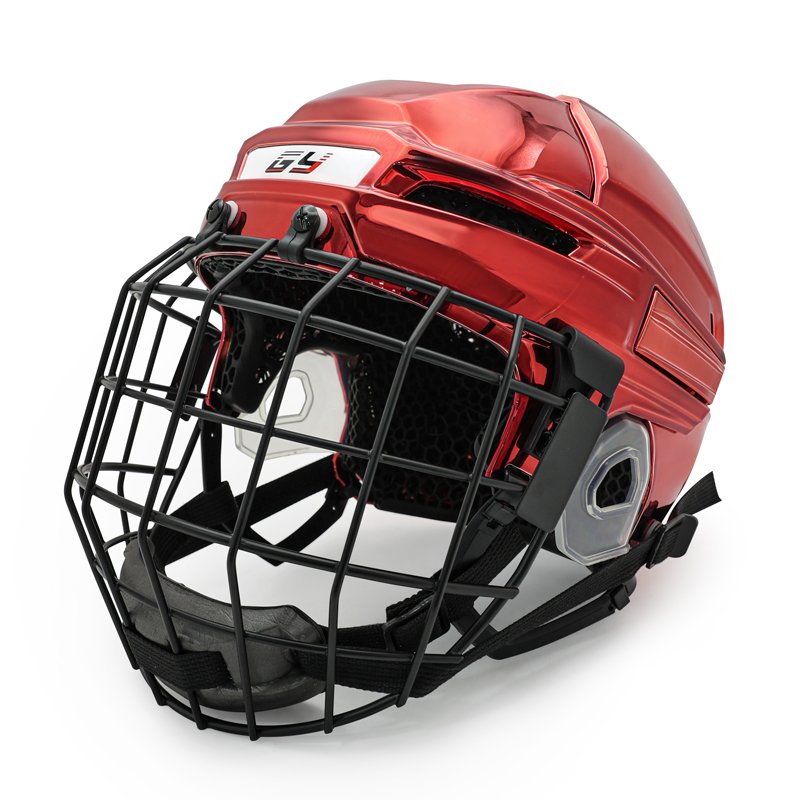
Beyond protection, a helmet must perform during a 60-minute game without causing fatigue or distraction. Traditional closed-cell foams act as insulators. They trap body heat against the skull. This leads to excessive sweating, discomfort, and increased perceived exertion. Equipment managers constantly deal with players complaining about overheating in older helmet models.
Thermal regulation is a primary benefit of 3D printed liners. The open-cell nature of the lattice consists mostly of air. This geometry actively facilitates airflow across the scalp as the player skates. Heat dissipates rapidly from the crown of the head. This results in physiological benefits such as reduced sweat dripping into the eyes, lower core temperatures, and improved late-game stamina. When a player skates at full speed, cold air rushes through the helmet vents and passes directly through the lattice, cooling the head instantly.
Fit and conformity also see significant upgrades. The lattice structure acts like a series of independent springs. It contours to asymmetrical head shapes far better than rigid foam blocks. This micro-adjustability eliminates the pressure points and hot spots commonly experienced during the break-in period of traditional helmets. The liner maps to the unique topography of the skull, ensuring maximum surface contact.
Increased surface contact means impact energy disperses over a wider area. It further enhances the protective qualities of the helmet. If a helmet only touches the head at four points, any impact force concentrates on those four points. A 3D printed liner touches the head across thousands of individual nodes. The force distributes evenly, reducing localized trauma.
Players also notice a difference in moisture management. Traditional foams absorb sweat over time, becoming heavy and harboring bacteria. The elastomeric polyurethane used in 3D printing does not absorb water. Sweat runs off the struts and evaporates quickly due to the high airflow. This keeps the helmet lighter throughout the game and makes it significantly easier to clean and dry between ice times.
Different manufacturers apply 3D printing to their flagship models in distinct ways. They focus on either continuous liner replacement or targeted digital foam integration. Understanding these approaches helps players choose the right system for their head shape and playing style.
CCM utilizes a continuous lattice design developed in partnership with Carbon 3D. Implemented in their top-tier models, it stands as the first NHL-certified 3D-printed liner. The design replaces nearly all traditional foam with the elastomeric matrix. This maximizes breathability and offers a highly uniform fit that conforms dynamically to the head. The continuous nature of the print means there are no seams or glue joints to fail over time.
Bauer approaches digital foam differently. They integrate 3D printed inserts alongside traditional foams. This hybrid approach often emphasizes personalized 3D head-scanning. They create custom inserts that match the exact contours of a player's skull. The 3D printed sections sit strategically placed in high-impact zones, blending the new technology with proven foam architectures. This allows for a familiar feel while upgrading protection in critical areas.
Feature | Traditional Foam (VN/EPP) | 3D Printed Lattice Liner |
|---|---|---|
Impact Absorption | Linear compression, static density | Multi-directional shear, progressive resistance |
Thermal Regulation | Poor (insulating closed-cell) | Excellent (open-air geometry) |
Fit Customization | Relies on shell adjustment | Micro-adjusts via independent struts |
Weight Distribution | Segmented blocks | Continuous, balanced matrix |
Moisture Retention | High (absorbs sweat over time) | Zero (non-porous material) |
When evaluating these technologies, players must consider their specific needs. A player who struggles with overheating will benefit most from a fully continuous lattice liner. A player who has a highly irregular head shape might prefer a hybrid system that utilizes a custom 3D scan to build bespoke inserts. Both systems represent a massive upgrade over standard retail foams.
Upgrading to a 3D printed liner involves evaluating conceptual trade-offs. The premium investment tier of these helmets requires buyers to weigh the benefits against their specific level of play. Elite and contact-level players benefit immensely from the advanced rotational impact management and thermal regulation. Casual or non-contact league players may find that a properly fitted mid-tier EPP/VN helmet provides adequate protection for their needs.
Durability and lifespan are common concerns. Elastomeric polyurethane offers distinct durability advantages over standard foams. Traditional foams harden, shrink, or pack out over time, losing their protective qualities. The elastomeric struts in a 3D printed liner resist this degradation. They maintain their rebound properties even after repeated impacts and exposure to sweat. The material does not become brittle in cold arenas, ensuring consistent performance regardless of the rink temperature.
Maintenance requires specific care. To clean a 3D printed liner without damaging the elastomeric material, players should avoid harsh chemicals or high-heat drying. Rinsing the liner with fresh water and allowing it to air dry in a well-ventilated area preserves the integrity of the lattice. Never leave the helmet in a hot car trunk or use a hair dryer on it, as extreme heat can warp the precision-engineered struts.
Fit discrepancies remain a risk when purchasing retail models. While the lattice conforms exceptionally well to the scalp, the outer polycarbonate shell must still match the player's overall head profile. A highly advanced liner cannot compensate for a shell that is fundamentally the wrong shape for the wearer. An oval head in a round shell will still experience pressure on the temples, regardless of the liner material.
Finally, the fallacy of DIY 3D-printed protection must be addressed. Home-printed helmets using consumer plastics like PLA or PETG are dangerous. These materials lack the shock-absorption properties, shear capability, and progressive resistance of certified elastomeric digital foam. They will shatter or transfer direct force to the skull upon impact. Using a homemade liner in an Ice Hockey Helmet is highly unsafe for any level of play and voids all HECC and CSA certifications.
Visit a certified equipment fitter to measure your specific head shape and determine if you have an oval or round profile.
Test the retail fit of various 3D printed models to ensure the outer polycarbonate shell aligns perfectly with your head shape without relying solely on the liner to fill gaps.
Verify that the HECC or CSA certification stickers are present and valid on the back of the helmet before taking it onto the ice.
Establish a routine of rinsing the helmet with fresh water and air-drying it after every game to maintain the integrity of the elastomeric lattice.
A: Elastomeric polyurethane lattices are generally comparable in weight to traditional EPP/VN foams, though some models may be slightly heavier. However, the continuous matrix design offers superior weight distribution, making the helmet feel balanced and less cumbersome during play.
A: No helmet prevents concussions. 3D liners excel at energy dispersion and managing rotational forces, which reduces impact severity. However, they cannot stop the brain from moving inside the skull upon sudden deceleration.
A: They adhere to the standard HECC certification lifespan, which is typically 6.5 years. Elastomeric materials actually resist the packing out or hardening that traditional foams suffer from over time, maintaining their protective properties longer.
A: No. Retail models use a standard shell with a highly adaptable 3D liner that micro-adjusts to your head. True custom models require a 3D scan for a bespoke liner fit, but retail versions still offer excellent conformity.
A: Absolutely not. Consumer 3D printing technologies and hobbyist materials do not possess the elastomeric, impact-absorbing properties of industrial DLS printing. DIY liners will shatter or fail to absorb energy, making them highly unsafe.
A: Rinse the liner with fresh water and use a mild soap if necessary. Always let it air dry at room temperature. Avoid high heat, hair dryers, or harsh chemical solvents, as these can degrade the elastomeric printed struts.


