

- Home
- Products
- HOT
- Technology
- Service
- Resources
- About
- Contact
- All
- Product Name
- Product Keyword
- Product Model
- Product Summary
- Product Description
- Multi Field Search

Views: 0 Author: Site Editor Publish Time: 2026-08-09 Origin: Site


Equipment failure in high-impact sports carries severe physical consequences. Players face significant risks of facial injuries, dental trauma, and concussions when relying on compromised or expired facial protection. A common problem persists across rinks: players and parents often rely on visual aesthetics rather than structural integrity to judge equipment lifespan. This leads to the continued use of expired, rusted, or structurally compromised ice hockey cages that fail under direct puck or stick impacts.
To ensure proper protection, you must establish a strict framework for evaluating current equipment condition. This involves navigating certification lifespans, assessing helmet shell integrity post-impact, and determining precise criteria for selecting a replacement. Understanding the exact mechanical limits of your gear prevents catastrophic failure on the ice.
Certification Expiration: HECC and CSA certifications mandate replacement after a specific timeframe (typically 6.5 years from the date of manufacture) regardless of visual condition, heavily impacting league eligibility.
Zero Tolerance for Deformation: Any bent wire, compromised weld, or structural deformity instantly ruins the impact dispersal capabilities of the cage, requiring immediate replacement to prevent catastrophic failure.
Material Trade-offs: Upgrading to a premium titanium cage offers weight relief, whereas a standard full face steel ice hockey cage delivers maximum durability and cost-effective impact resistance.
Shield vs. Cage Lifespans: Polycarbonate visors and hybrid combos degrade chemically and physically much faster than metal cages, carrying a strict maximum lifespan of 5 years.
System Integrity: A severe impact that damages a cage often damages the underlying helmet structure; players must evaluate both components to ensure complete head safety.
A dangerous discrepancy exists between a cage looking fine and possessing the structural integrity to withstand a 90 mph slap shot. Visual inspections alone cannot confirm internal metal strength. You must understand the testing protocols and material science behind the equipment to make informed replacement decisions.
The Hockey Equipment Certification Council (HECC) and Canadian Standards Association (CSA) enforce rigorous testing standards. These organizations determine how much force protective gear can safely absorb through standardized drop tests and high-velocity projectile impacts. They mandate a strict 6.5-year expiration rule from the date of manufacture. You can find this date printed directly on the certification sticker attached to the helmet and cage.
This certification sticker dictates league acceptance. Missing, painted-over, or illegible HECC/CSA stickers fail referee pre-game safety inspections. If the sticker is gone, the cage is illegal for play in sanctioned games. Referees will remove players from the ice until they secure certified equipment. The 6.5-year limit is not arbitrary; it represents the maximum duration the materials can reliably absorb impact energy before environmental and physical degradation compromises their safety margins.
Certification Body | Region of Authority | Standard Lifespan | Primary Testing Focus |
|---|---|---|---|
HECC | USA Hockey | 6.5 Years | Impact velocity and penetration resistance |
CSA | Hockey Canada | 6.5 Years | Structural integrity and wire deformation limits |
CE | European Leagues | Varies by manufacturer | Field of vision and material toxicity |
Repeated minor impacts alter the metallurgical reality of steel and titanium. Every stick slash, board collision, and puck deflection transfers kinetic energy through the metal grid. Over seasons of play, micro-fractures develop at the weld points and along the wire shafts. Stress-corrosion cracking progressively reduces the tensile strength of the metal.
This fatigue happens even if no visible bending is apparent. The metal becomes brittle over time. A cage that survived hundreds of minor impacts might suddenly fail catastrophically under a routine hit due to invisible structural fatigue. The constant temperature fluctuations between a freezing ice rink and a warm locker room accelerate this metallurgical degradation, causing the metal lattice to lose its elasticity and impact-absorbing properties.
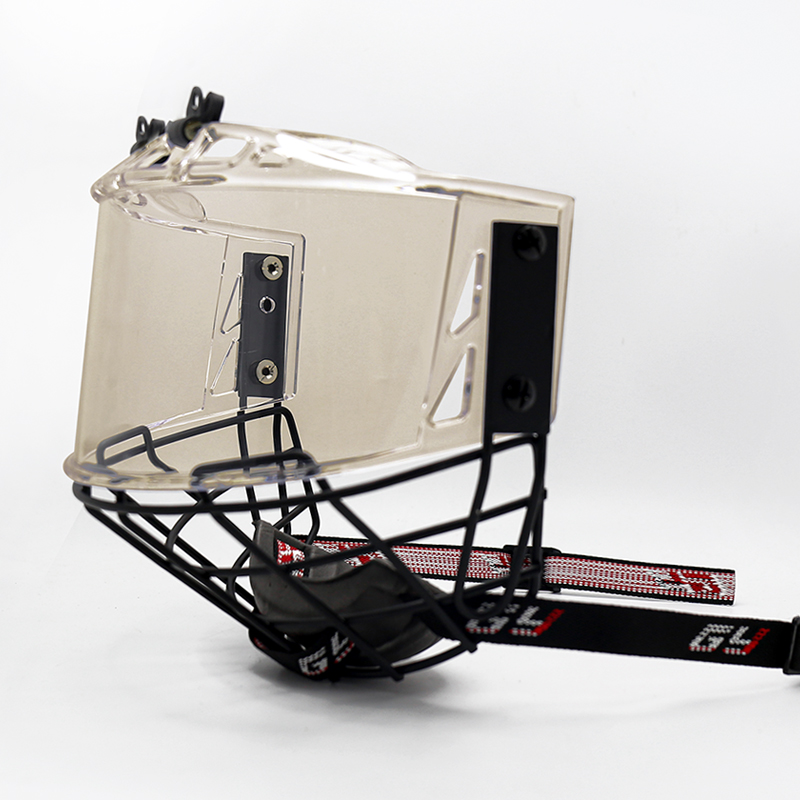
You need a definitive diagnostic checklist for inspecting current protective equipment. Identifying structural compromises before ice time prevents severe injuries. Do not wait for a referee to point out a flaw during a pre-game check.
Engineers design the geometric grid of a cage to disperse kinetic energy across the entire helmet shell. A single bent wire disrupts this energy transfer. It concentrates the force of subsequent impacts directly onto the player's face rather than distributing it outward to the helmet's mounting points.
Never attempt to bend a deformed wire back into place. Bending metal twice severely weakens its structural integrity, creating a localized weak point that will snap under pressure. Any visible dent requires immediate replacement of the entire unit.
Moisture from sweat and melted ice creates a highly corrosive environment. Rust typically forms at wire intersections, joints, chin cup attachment points, and areas of chipped paint. Rust eats away at the welds holding the cage together. This leads to catastrophic failure where wires snap inward upon puck impact, directly threatening the eyes and teeth.
Surface rust can sometimes be wiped away, but deep pitting indicates structural compromise. If you can feel the rust digging into the metal with your fingernail, the weld is failing. Inspect the interior side of the cage closely, as this area receives the most direct moisture from the player's breath and sweat.
A cage is only as safe as its mounting points. Evaluate the supporting hardware regularly. You must identify when to replace just the mounting hardware versus replacing the entire cage assembly.
Replace rusted or stripped screws immediately to prevent the cage from detaching during a collision.
Inspect J-clips for hairline cracks; replace if damaged, as these clips stop the cage from smashing into your jaw.
Check chin cup padding for hardening or tearing, which can cause severe lacerations upon impact.
Ensure side snaps hold tension securely and do not pop open under light pressure.
Verify that the dome screws anchoring the top hinges are not stripping the plastic threads of the helmet shell.
A high-energy impact that bends a cage often compromises the helmet shell. You must address whether a severe collision requires a full helmet replacement. Inspect the helmet shell for hairline cracks radiating from the mounting screws. Check the EPP or EPE foam liners for permanent compression. If the foam feels rock hard, fails to rebound after being pressed, or the shell shows stress marks, replace the entire helmet system. The cage and helmet work as a unified energy-management system; a failure in one component overloads the other.
Replacement intervals and safety criteria differ heavily based on the player's position. The specific velocity of impacts dictates equipment lifespan and inspection frequency.
Skaters face errant high sticks, deflected pucks, and sudden collisions with glass or boards. The recommended replacement frequency for standard player cages varies across levels of play. High-exposure travel hockey players should replace cages every two to three seasons due to the sheer volume of impacts. Recreational players might safely reach the 6.5-year certification limit if no impacts deform the metal.
For skaters, the primary threat is often a stick blade riding up the chest and striking the lower half of the cage. Inspect the lower horizontal bars and the chin cup assembly after every game involving heavy physical play.
Goalie cages endure a high-velocity, direct-impact profile. Goalies must adhere to strict replacement rules for dented cages. They should replace cages significantly more often than skaters due to repeated direct puck impacts. A goalie cage takes the full force of a shot without the body absorbing any of the kinetic energy.
Certified straight-bar cages offer maximum protection and meet all league standards. Non-certified cat-eye cages provide better sightlines but carry severe risks. Stick blades and the butt-end of sticks can penetrate the larger eye openings of non-certified cat-eye cages. Goalies using cat-eye cages must inspect the welds around the eye openings daily, as these are the most common failure points under heavy bombardment.
Position | Primary Impact Threat | Inspection Frequency | Typical Replacement Cycle |
|---|---|---|---|
Forward/Defense | High sticks, elbows, deflected pucks | Weekly | 2-4 Seasons |
Goaltender | Direct high-velocity puck impacts | Daily | 1-2 Seasons |
Compare available aftermarket replacement options based on durability, weight, field of vision, and cost. Selecting the right material depends on your level of play and maintenance habits.
Traditional carbon steel and stainless steel cages remain the industry standard. A Full Face Steel Ice Hockey Cage delivers outstanding structural durability. It provides high resistance to minor impacts and maintains its shape well under stress.
Steel is the heaviest option on the neck, which can contribute to fatigue during long tournaments. It is also susceptible to rust if stored wet in closed hockey bags. Proper drying extends its practical lifespan. You must remove the helmet from the gear bag immediately after practice and wipe down the wire intersections with a dry towel.
Titanium alloy alternatives offer premium performance. They are up to 50% lighter than standard steel cages. Titanium is highly rust-resistant and offers an excellent strength-to-weight ratio, significantly reducing neck strain for players on the ice for long shifts. Despite its strength, titanium can still bend under extreme force and requires the same visual inspections as steel. The material does not rust, but the welds can still suffer from fatigue cracking over time.
Clear shields and integrated cage/shield combos provide superior peripheral vision. They offer an unobstructed sightline, which many playmakers prefer. However, they suffer from a shorter lifespan due to surface scratches and anti-fog coating degradation.
Non-metal shields carry a strict 5-year lifespan limit. Plasticizers leach out of the polycarbonate over time. This chemical degradation makes the plastic brittle and highly prone to cracking under cold-weather impacts. Once a polycarbonate shield sustains a deep scratch directly in the line of sight, it must be replaced, as the scratch will refract rink lighting and blind the player.
Mounting a new cage onto an existing helmet presents technical challenges and safety hazards. Proper installation is critical to ensure the energy dispersal system functions as engineered.
Cage size does not always mirror helmet size. A player with a long face wearing a Medium helmet may require a Large cage for proper chin coverage. You must perform a physical measurement process. Measure from the hairline to the tip of the chin to determine the correct cage length. If the cage is too small, the chin cup will ride up into the mouth. If the cage is too large, it will hang below the jaw, exposing the throat to pucks and sticks.
Mixing brands requires careful evaluation. Mounting a Bauer cage onto a CCM or Warrior helmet often works, but not always. Universal four-point mounting systems generally allow cross-brand compatibility. However, proprietary helmet designs require brand-specific hardware configurations. Always test the mounting points before finalizing a purchase. The top hinges must align perfectly with the helmet's pre-drilled holes without forcing or bending the metal tabs.
Use this definitive safety checklist for a properly fitted replacement cage:
The chin cup fits snugly and squarely against the chin. It must not hang down or press into the throat.
The cage rests securely within the J-clips. This prevents upward movement or direct facial contact during frontal impacts.
No physical gaps exist between the helmet and the cage temple guards wide enough for a stick blade to penetrate.
The top mounting screws are tightened securely without stripping the internal helmet threads.
The side straps have enough tension to keep the cage locked into the J-clips without pulling the helmet down over the eyebrows.
Inspect your current facial protection immediately for deep rust, bent wires, or expired HECC/CSA certification stickers.
Measure your face from the hairline to the chin to ensure your replacement cage provides adequate coverage, regardless of your helmet size.
Select a high-quality steel cage for maximum durability, or invest in a titanium model if you experience neck fatigue during play.
Replace all rusted screws, cracked J-clips, and worn chin cups when installing the new cage to guarantee the mounting system holds under impact.
A: HECC and CSA certifications for metal hockey cages are valid for exactly 6.5 years from the date of manufacture. You must replace the cage once this date passes to remain eligible for sanctioned league play.
A: No. Bending metal weakens its structural integrity. A wire bent back into place will fail much faster under a subsequent impact, putting your face at severe risk.
A: Not necessarily. Most modern helmets use a universal four-point mounting system. However, you must verify that the J-clips and top hinges align perfectly without forcing the hardware.
A: Rust forms when sweat and melted ice remain on the metal, especially if stored in a closed, unventilated hockey bag. Chipped paint also exposes the raw steel to moisture.
A: The chin cup should rest snugly and squarely against the bottom of your chin. It should not hang loosely below the jaw or press tightly into your throat.
A: Both materials pass the same rigorous HECC/CSA safety standards. Titanium is significantly lighter and resists rust better, but steel offers excellent, cost-effective impact resistance.


