

- Home
- Products
- HOT
- Technology
- Service
- Resources
- About
- Contact
- All
- Product Name
- Product Keyword
- Product Model
- Product Summary
- Product Description
- Multi Field Search

Views: 0 Author: Site Editor Publish Time: 2026-08-12 Origin: Site


Heavy headgear takes a physical toll on players during high-speed play. It directly contributes to neck fatigue, delayed reaction times, and impaired peripheral tracking. When every fraction of a second matters on the ice, carrying unnecessary weight on your helmet degrades performance late in the third period. Players must balance the absolute need for maximum facial impact protection and league compliance with the desire for minimal weight and unobstructed visibility. Material science serves as the primary differentiator in modern facial protection. The metals and polymers used in manufacturing dictate how a mask performs under impact, how it resists environmental degradation, and how much strain it places on the neck. Establishing a clear framework to evaluate steel, titanium, and polycarbonate options based on performance outcomes allows players to make informed decisions. Understanding these materials ensures you select the right protection for your specific level of play.
Titanium offers the highest strength-to-weight ratio: It provides up to a 40% weight reduction compared to traditional materials, ideal for competitive players prioritizing neck fatigue reduction.
Steel remains the baseline for durability: Carbon and stainless steel options deliver uncompromising impact protection and longevity for recreational and intermediate play.
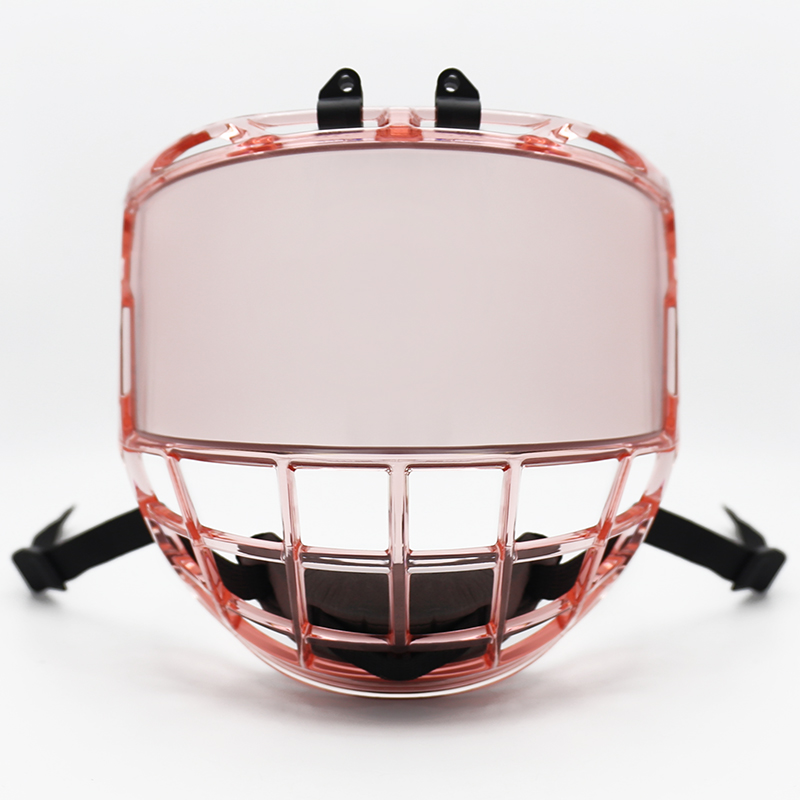
Polycarbonate maximizes optical clarity: A polycarbonate full face hockey shield eliminates wire obstruction but introduces maintenance variables regarding airflow, fogging, and scratch resistance.
Compatibility and certifications dictate adoption: Material choice must align with existing helmet hardware, sizing specifications, and league certification requirements (HECC/CSA/CE).
Defining the acceptable thresholds for weight savings without compromising impact deflection capabilities dictates the design of modern facial protection. A lighter mask reduces the pendulum effect on the head during rapid directional changes. This minimizes neck strain over a long tournament weekend. However, this weight reduction cannot come at the expense of structural integrity. The material must withstand high-velocity puck impacts and errant sticks without permanently deforming or shattering. Manufacturers engineer these masks to absorb and distribute kinetic energy across the helmet's mounting points. The challenge lies in finding a material thin enough to save weight but strong enough to prevent the cage from collapsing inward during a collision. You need a cage that absorbs a slapshot without bending into your nose.
Material strength directly dictates wire thickness and bar shape. This heavily impacts peripheral vision and downward sightlines. Weaker materials require thicker wires to achieve the necessary impact ratings, creating larger blind spots. High-tensile materials allow for thinner wire profiles. The shape of the wire alters how the eye processes the obstruction. Flat or oval wires present a narrower profile to the player's line of sight while maintaining structural depth against frontal impacts. This optical geometry helps players track the puck at their feet without constantly dropping their heads. When you look down to stickhandle, a flat wire profile blurs out of your vision much faster than a thick, round bar.
Baseline expectations for how sweat, melting ice, and locker room moisture degrade different materials over a standard playing season vary significantly. Hockey equipment exists in a highly corrosive environment. Salt from sweat and prolonged exposure to damp gear bags accelerate oxidation in susceptible metals. A high-quality mask must resist this environmental degradation to maintain its structural integrity. When rust takes hold at the weld points of a wire mask, it compromises the strength of the entire grid. You must replace the mask immediately when welds rust, regardless of how the rest of the cage looks.
Governing bodies strictly regulate facial protection standards. These organizations certify different materials and designs for specific age categories and skill levels through rigorous impact testing. A mask must pass drop tests, puck impact simulations, and penetration tests to earn its certification sticker. Players must verify that their chosen material and design meet the specific requirements of their league. Utilizing uncertified or expired equipment results in penalties and severe safety risks on the ice.
Common Hockey Helmet Certification Standards | |||
Certification Body | Region | Testing Focus | Sticker Validity |
|---|---|---|---|
HECC | United States | Impact absorption, penetration resistance | Valid for 6.5 years from manufacture |
CSA | Canada | Wire strength, puck deflection, hardware retention | Valid until damaged or degraded |
CE | Europe | Field of vision, shock absorption, material toxicity | Valid until damaged or degraded |
The manufacturing process of carbon steel wire masks involves drawing the steel into specific gauges, cutting it to length, and precision-welding the grid before shaping it to fit a helmet profile. Carbon steel provides a standard weight profile that most players are accustomed to. It delivers uncompromising durability against high-velocity impacts. Because it is relatively straightforward to manufacture and weld, carbon steel remains the most accessible option for entry-level and recreational players who need reliable protection without specialized lightweight requirements. You will find carbon steel on almost every rental helmet and beginner kit.
To prevent rapid oxidation, manufacturers rely on powder coating or heavy paint applications. This protective layer seals the raw carbon steel from moisture and sweat. The rigorous nature of hockey means this coating inevitably chips from stick slashes and puck deflections. Once the raw steel is exposed to the damp environment of a hockey rink or equipment bag, moisture penetration begins. Rust can quickly develop at these chipped locations, particularly around the critical weld joints. Players using carbon steel must regularly inspect their gear for compromised welds to ensure ongoing safety. A quick visual check before taping your stick can prevent a catastrophic failure on the ice.
Stainless steel offers distinct metallurgical advantages in resisting oxidation and rust from sweat and locker room moisture. By incorporating chromium into the steel alloy, manufacturers create a material that naturally resists the corrosive environment inherent to hockey. This eliminates the strict reliance on powder coatings to prevent structural degradation. Even if a stainless steel mask takes a heavy slash that scratches the surface, the underlying metal will not rapidly rust like carbon steel. This makes stainless steel an excellent choice for players who play frequently and leave their gear in damp environments.
When comparing the weight and rigidity of stainless steel against carbon steel, the differences are marginal. Both materials provide exceptional stiffness and impact deflection. The on-ice feel remains largely identical, with the primary benefit being longevity rather than performance enhancement. Players opting for stainless steel prioritize a mask that will survive multiple seasons of heavy use without developing the unsightly and dangerous rust spots common to standard carbon steel alternatives. You get the same protection but spend less time worrying about drying your helmet perfectly after every skate.
Titanium boasts an exceptional strength-to-weight ratio, making it the premier choice for elite ice hockey cages. It provides the same impact resistance as steel but at a fraction of the weight. This dramatic reduction in mass leads to highly desirable performance outcomes. Players experience noticeably reduced neck strain over the course of a long game or tournament. The lighter front end allows for faster head mobility, enabling quicker visual scanning of the ice. Because titanium is inherently stronger, manufacturers can use thinner wire profiles, which significantly improves sightlines and reduces visual obstruction.
Pure titanium options face market availability and scarcity issues. Historically, the market has been dominated by select premium offerings, leading to supply constraints. Manufacturing and welding titanium requires specialized environments and inert gases, making the production process far more complex than steel. Players must evaluate whether the significant performance gains align with their frequency of play and competitive level. For those on the ice four to five times a week, the physical benefits of titanium often justify the upgrade. The difference in neck fatigue after a three-game weekend is immediately noticeable.
High-grade optical polycarbonate is engineered for extreme impact resistance and shatterproof qualities. Unlike standard plastics, polycarbonate absorbs and disperses kinetic energy, preventing it from cracking or shattering upon impact from a puck or stick. This resilience makes it an ideal material for facial protection. The manufacturing standards required to produce these shields are incredibly stringent. To achieve zero visual distortion in curved shield designs, the polycarbonate must be optically correct. Any inconsistencies in the material thickness or curvature will cause a funhouse-mirror effect, severely disrupting a player's hand-eye coordination and depth perception. You cannot catch a hard pass if the puck looks like it is warping across the ice.
When comparing the exact weight of a standard Polycarbonate Full Face Hockey Shield against steel and titanium wire cages, the polycarbonate option generally sits between the two metals. It is lighter than standard carbon steel but often slightly heavier than premium titanium due to the density of the plastic and the necessary mounting hardware. The most significant difference lies in airflow dynamics. Solid shields inherently restrict ventilation compared to the open matrices of wire cages. This restricted airflow can lead to increased facial heat and heavy sweating during intense shifts.
To combat the lack of ventilation, manufacturers apply factory anti-fog and anti-scratch coatings to the polycarbonate. While these coatings are highly effective initially, players must set realistic expectations for degradation over time. Sweat, abrasive cleaning cloths, and general locker room wear will eventually break down these factory treatments. Once the anti-fog layer degrades, the shield becomes susceptible to condensation. Players must utilize aftermarket sprays and strict maintenance routines to maintain visibility. Wiping the shield with a dirty jersey on the bench will ruin the coating instantly.
Visors serve as a partial-protection polycarbonate alternative, covering only the eyes and upper nose. This half-shield design offers maximum weight reduction and completely unrestricted ventilation to the lower half of the face. Players wearing visors experience superior airflow and zero visual obstruction looking downward at the puck. This comes with severe safety trade-offs. The lack of chin, jaw, and dental protection exposes players to catastrophic injuries from deflected pucks and high sticks. Due to these risks, strict league age restrictions govern half-shields, typically limiting their use to adult leagues and professional levels where players assume the risk of dental injury.
Hybrid masks attempt to merge the best attributes of both materials by mating a high-impact polycarbonate upper visor to a steel or titanium lower cage. The architecture of these masks focuses on providing the optical clarity of a shield across the primary line of sight while utilizing the breathability of a wire cage around the mouth and chin. This design synergy targets players who despise looking through upper wires but cannot tolerate the heat retention and fogging issues associated with a fully enclosed polycarbonate shield. The lower wire section allows for easy communication on the ice and unrestricted airflow for heavy breathing.
Evaluating the overall weight of hybrid models reveals a distinct trade-off. The combination of heavy-duty mounting hardware required to securely join the plastic and metal components often makes hybrid masks heavier than pure titanium or fully polycarbonate options. The integration joints between the rigid polycarbonate and the metal wire introduce structural weak points. Manufacturers must heavily reinforce these overlapping areas to ensure the mask passes certification testing. While hybrids offer a unique visual and ventilation balance, players must accept the added bulk and weight that comes with this dual-material construction. You get the vision of a shield and the breathability of a cage, but you carry more weight on your forehead.
Material Comparison for Hockey Facial Protection | ||||
Material Type | Weight Profile | Airflow | Maintenance Level | Visual Obstruction |
|---|---|---|---|---|
Carbon Steel | Heavy | Maximum | Low (Dry after use) | High (Thick wires) |
Titanium | Ultra-Light | Maximum | Very Low | Low (Thin wires) |
Polycarbonate Shield | Medium | Restricted | High (Anti-fog/scratch) | Zero |
Hybrid (Plastic/Wire) | Heavy | Moderate | High | Low (Upper clear) |
Selecting the right material depends heavily on the frequency and intensity of play. Competitive players engaging in high-frequency play and facing elite shot velocities benefit immensely from investing in titanium. The weight reduction minimizes cumulative fatigue over a long season, and the superior sightlines aid in high-speed puck tracking. Recreational players participating in casual, lower-impact games are generally better served by steel. Carbon or stainless steel provides maximum durability and safety without the need for specialized lightweight properties, making it the most practical choice for adult league participants playing once a week.
Proper fitment is non-negotiable for facial protection. Evaluating cross-brand helmet compatibility is also crucial. While many cages are universal, fitting a specific brand's cage onto a different manufacturer's helmet can sometimes result in alignment issues. Players must carefully adjust the J-clips and the chin cup to ensure the mask locks securely into place, maintaining certified safety alignment upon impact. If the chin cup floats an inch below your jaw, the mask will slam into your teeth during a collision.
Measure the distance from the bridge of your nose to the prominent tip of your chin using a soft tape measure.
Compare this measurement against the specific manufacturer's sizing chart, as a medium in one brand may fit like a large in another.
Attach the top hinges loosely to the helmet, allowing the cage to swing freely.
Align the J-clips on the side of the helmet so the cage rests securely inside the clips without requiring force to snap it shut.
Adjust the chin cup straps so the cup sits firmly against your chin when the helmet is buckled.
Players must evaluate how their brain processes visual obstructions. Some players seamlessly look past traditional round steel wires, while others find them highly distracting. For those sensitive to visual interference, flat-wire or oval-wire designs in steel and titanium offer a significantly thinner visual profile, reducing the perceived obstruction. If any wire presence is completely intolerable, a polycarbonate shield is the only viable solution. Players must physically test the sightlines of different wire geometries and solid shields to determine which material allows them to track the puck most naturally. Put the helmet on in the pro shop and look down at a puck on the floor to test the sightlines.
Maintaining steel cages requires strict protocols to prevent rust and structural degradation. Post-game drying is essential; players must remove their helmets from damp gear bags and allow them to air dry completely. Leaving a steel mask sitting in sweat accelerates oxidation rapidly. Regular inspection of the welds is also necessary. Players should check for any chipped paint or signs of orange rust forming at the joints. If rust compromises a weld, or if the wire becomes bent from a heavy impact, the structural integrity is lost, and the mask must be replaced immediately to ensure continued safety.
Polycarbonate shields demand rigorous maintenance to preserve their optical clarity. Players must adhere to strict cleaning guidelines, utilizing only approved anti-fog solutions and dedicated microfiber cloths. Using abrasive towels or harsh chemicals will strip the factory coatings and permanently scratch the plastic. Players must protect the shield off the ice. Tossing a helmet unprotected into a gear bag alongside skates and hard plastics guarantees deep scratches. Utilizing a fleece helmet bag and avoiding locker room abrasions are mandatory practices for anyone choosing a polycarbonate shield.
Regardless of the material chosen, the mounting hardware requires constant vigilance. Players must routinely verify that the J-clips, top mounting screws, and chin cup straps are tight and properly aligned. Loose hardware allows the mask to shift upon impact, transferring kinetic energy directly to the face rather than dispersing it through the helmet shell. Ensuring the chosen material does not alter the helmet's certified fit is paramount. If attaching a new mask forces the helmet to pinch the temples or lift off the forehead, the compatibility is flawed, and the setup is no longer safe for gameplay.
Measure your face accurately from the bridge of the nose to the chin to determine your exact cage size.
Verify the mounting hardware compatibility between your current helmet shell and the new facial protection.
Test the downward sightlines of flat-wire versus round-wire options by tracking a puck on the floor.
Purchase a dedicated fleece helmet bag and microfiber cloths if you select a polycarbonate shield.
Inspect your current cage for rusted welds or bent wires and replace the hardware immediately if compromised.
A: Yes, polycarbonate shields can fog up, especially in humid rinks or if the player sweats heavily. While they come with factory anti-fog coatings, these degrade over time. Players must use approved anti-fog sprays and maintain strict cleaning routines to minimize condensation and preserve visibility.
A: Titanium cages are the lightest full-face wire options available. They provide up to a 40% weight reduction compared to standard carbon steel cages while maintaining exceptional strength and impact resistance, significantly reducing neck fatigue.
A: While many cages are designed to be universal, perfect compatibility is not guaranteed across all brands. You must ensure the mounting points align correctly and that the J-clips and chin cup secure the mask without altering the helmet's certified fit on your head.
A: Measure the distance from the bridge of your nose down to the prominent tip of your chin. Match this measurement with the manufacturer's sizing chart. The chin cup should fit snugly against your chin, and the mask should not hang below your jawline.
A: A high-quality steel cage can last several years if properly maintained. However, it must be replaced immediately if the wires become bent from an impact, if the paint chips significantly, or if rust develops at the weld joints, as these compromise structural integrity.
A: Stainless steel is highly superior in terms of corrosion resistance. It naturally resists rust caused by sweat and moisture without relying on paint or powder coatings. While the weight and impact protection are similar, stainless steel offers much better longevity in damp environments.


